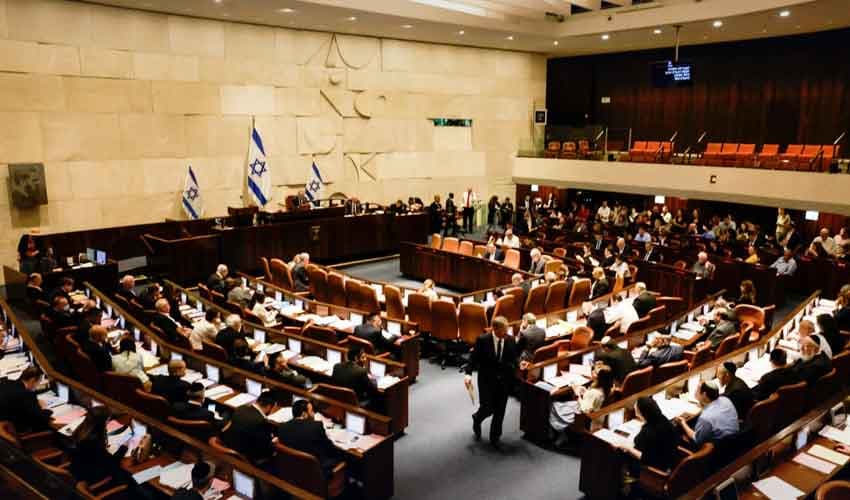
Israel has officially entered election mode after the Knesset dissolved following the passage of a series of key and controversial bills.
The move sets the stage for parliamentary elections on October 27 as Prime Minister Benjamin Netanyahu seeks to retain power amid shifting political dynamics.
Israel's parliament, the Knesset, dissolved early Friday after lawmakers approved the measure overnight, formally ending the current parliamentary term and clearing the way for national elections on October 27.
The Knesset had been scheduled to begin its summer recess on Friday, but with its dissolution, lawmakers will not reconvene before Israelis head to the polls.
Until a new government is formed following the election, Netanyahu's administration will continue to serve in a caretaker capacity, with its authority generally limited to routine government affairs.
Netanyahu faces growing political pressure
The elections come at a politically sensitive time for Prime Minister Benjamin Netanyahu, who is fighting to remain in power as Israel approaches the third anniversary of the October 7 attack, which triggered nearly three years of conflict.
Recent opinion polls indicate growing support for opposition parties led by former Prime Minister Naftali Bennett and a popular centrist former military chief, posing a significant challenge to Netanyahu's governing coalition.
In the final days before dissolution, the Knesset held marathon sessions to pass a series of major bills spanning security, judicial and social issues.
Among the most controversial measures were two bills that effectively halted the enlistment of ultra-Orthodox men into military service. The legislation is widely seen as an effort to secure the support of ultra-Orthodox political parties for Netanyahu's future coalition.
Lawmakers also approved a temporary law extending mandatory military service from 30 months to 32 months. According to the bill's explanatory notes, the extension is intended to help the Israel Defense Forces meet operational demands and ongoing security requirements.
Judicial, governance reforms approved
The Knesset also passed several measures linked to Netanyahu's long-running judicial overhaul agenda.
The legislation includes changes that increase government oversight of broadcast media and a bill splitting the role of the Attorney General, a move critics say weakens institutional checks and balances.
Attorney General Gali Baharav-Miara, who has repeatedly opposed the government's judicial overhaul plans, has frequently been targeted by Netanyahu and members of Israel's political right.
Other legislation approved before parliament dissolved included the Basic Law on Torah Study, a bill ending the arrest of draft evaders, legislation allowing gender-segregated academic programs for advanced degrees, and amendments to communications regulations.
Knesset speaker marks rare full parliamentary term
Announcing the dissolution of parliament, Knesset Speaker Amir Ohana highlighted the government's achievement in completing a full four-year term.
"We are completing a four-year term, we passed nine budgets and hundreds of bills. I thank you for the trust you placed in me, through which together we succeeded in maintaining a four-year term," Ohana said.
Completing a full parliamentary term is unusual in Israeli politics. The last Israeli government to serve a complete term without early elections was in 1988.
Although Netanyahu has served more terms than any other prime minister in Israel's history, even his governments have rarely completed a full four-year mandate.
Between 2019 and 2022, Israelis voted in five national elections, reflecting prolonged political deadlock.
According to the Israel Democracy Institute, Israel holds elections approximately every 2.4 years, making it the OECD country with the second-shortest average interval between elections -- a sign of persistent political instability.
Election campaign officially begins
With parliament now dissolved, Israel's election campaign has formally begun.
Political parties will now finalize candidate lists, negotiate alliances and launch nationwide campaigns as they compete for seats in the 120-member Knesset ahead of the October 27 vote.