China and Pakistan have jointly called on the United States and Iran to immediately halt military hostilities and return to the negotiating table, as renewed fighting in the Strait of Hormuz threatens to derail last month's ceasefire agreement and deepen instability across the Middle East.
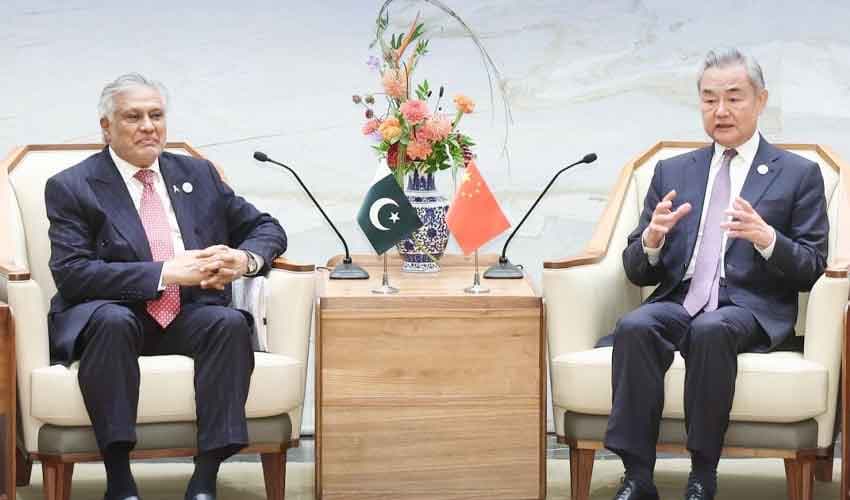
The appeal came after a meeting between Chinese Foreign Minister Wang Yi and Pakistan's Deputy Prime Minister and Foreign Minister Ishaq Dar in Shanghai on Friday.
According to a statement issued by China's Foreign Ministry, the two leaders expressed deep concern over the deteriorating security situation and urged both Washington and Tehran to stop fighting.
"China's Wang Yi and Pakistan's Ishaq Dar jointly expressed concern over the deterioration of the current situation, calling on the involved parties to immediately cease hostilities and return to dialogue," the statement said.
Both ministers also called on all parties to fulfill their commitments and abide by the ceasefire memorandum of understanding.
Yi says hard-won peace must be protected
Speaking after the meeting, Wang Yi stressed that the previous diplomatic breakthrough should not be allowed to collapse.
He described the memorandum of understanding reached last month as "hard-won" and urged all sides to preserve the progress already achieved.
"Peace is before our eyes; we cannot fall at the last hurdle and even more so cannot lose what we have gained," Wang said.
Pakistan continues diplomatic engagement
Pakistan has been actively engaged in diplomatic efforts aimed at reducing tensions between the United States and Iran.
Dar was in Shanghai to attend the World Artificial Intelligence Conference, where he also held talks with his Chinese counterpart on the rapidly evolving Middle East crisis.
China and Pakistan have both sought to mediate the months-long conflict, which reignited after renewed military confrontation in and around the Strait of Hormuz despite last month's preliminary agreement intended to end the war.
US-Iran fighting intensifies again
The diplomatic appeal came as the United States and Iran exchanged another round of military strikes on Friday.
Iran accused Washington of targeting civilian infrastructure during its latest airstrikes, including an airport, a railway station, two bridges.
Also Read: Iran's IRGC claims targeting US command centre in Syria
The United States also expanded its air campaign by striking additional bridges and collapsing a communications tower at a key Iranian port.
The latest attacks follow repeated warnings by US President Donald Trump that Washington could target Iranian infrastructure if Tehran continued efforts to assert control over the Strait of Hormuz.
Iranian officials said the US strikes killed dozens of people and injured hundreds more, with additional casualties reported following Friday's attacks.
Iran launches fresh attacks in region
In response to the latest US strikes, Iran announced it had launched a new wave of drone attacks targeting US military allies and infrastructure in Kuwait.
Iran also carried out missile attacks against several countries across the Middle East, including Qatar, which has been serving as one of the key mediators in the conflict alongside Pakistan.
The renewed exchanges have effectively collapsed the interim ceasefire agreed last month, replacing diplomacy with days of sustained military confrontation.
Strait of Hormuz tensions continue to rise
The latest fighting has once again centered on the Strait of Hormuz, one of the world's most strategically important maritime routes for oil and gas exports.
The waterway briefly reopened after the US-Iran agreement signed in June. However, Tehran announced last week that the Strait of Hormuz would remain closed "until the US ends its aggression."
Also Read: Conflict escalates as new US strikes hit southern Iran; Tehran targets US bases again
Meanwhile, the United States has reimposed a naval blockade on Iranian ports, further increasing tensions in the Gulf.
The joint statement from China and Pakistan underscores growing international concern that the conflict could spiral further if negotiations do not resume.
By urging all parties to honor the memorandum of understanding and return to dialogue, Beijing and Islamabad signaled their determination to preserve the fragile diplomatic progress achieved just weeks ago despite the rapidly escalating military confrontation.