US President Donald Trump on Thursday accused China of interfering in American elections, ordered the FBI to investigate the alleged activities, and declassified intelligence documents he said expose serious weaknesses in the US electoral system.
The claims, however, contrast with previous US intelligence assessments that found no evidence Beijing altered the outcome of the 2020 presidential election.
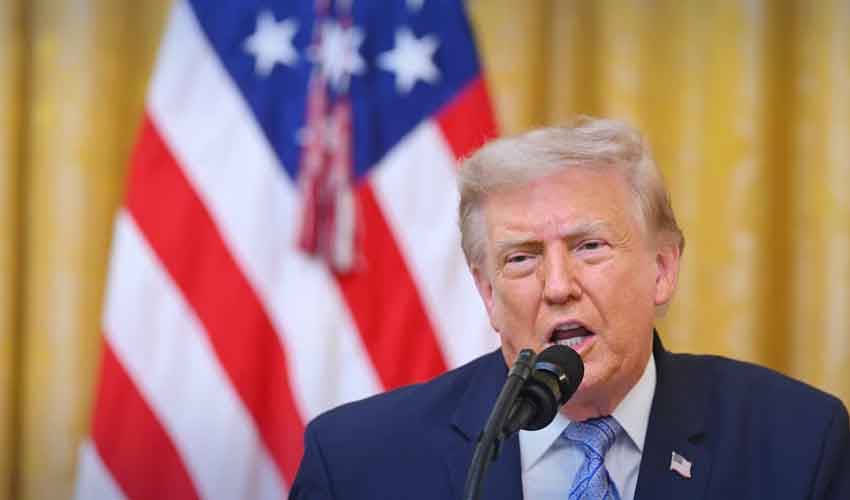
In a 25-minute prime-time address to the nation, Trump announced that he had directed the FBI to investigate what he described as Chinese interference in US presidential elections.
He also ordered the immediate declassification of intelligence documents, claiming they reveal "shocking vulnerabilities" in America's election infrastructure and expose the extent of China's activities.
Trump alleged that China carried out the "largest theft of voter data" in US history, saying Beijing obtained information on about 220 million American voter files, including names, addresses, and other personal details. He also claimed China stole the data of approximately 20 million Americans during the 2020 election.
According to the president, the US electoral system continues to face hacking attempts and foreign interference, and he stressed that "no country can become great until elections are fair."
Trump said he wants an electoral system free from fraud, cyberattacks, and foreign influence.
President criticises TV networks over speech coverage
During his address, Trump expressed frustration that several major television networks chose not to broadcast his speech live.
He accused the channels of denying the public access to important information and demanded that their broadcasting licenses be revoked.
Reuters reported that two of the three major US television networks, along with CNN, declined to air the speech on their primary platforms, saying such coverage is typically reserved for issues of major national importance.
Trump's address highlighted his renewed effort to make election security a key political issue ahead of the November midterm elections, where Republicans will be defending narrow congressional majorities.
The president briefly addressed the ongoing Iran conflict at the beginning of his speech, saying the United States was "winning big." He also highlighted tax cuts, immigration enforcement, and other domestic achievements before shifting focus to election integrity.
Trump again urged Republican lawmakers to pass the SAVE America Act, legislation that would require voters to present photo identification, prove US citizenship before registering to vote, and significantly restrict mail-in voting.
The bill has passed the Republican-controlled House of Representatives multiple times but remains stalled in the Senate, where Democrats have enough votes to block it through a filibuster.
Democrats and voting rights advocates argue the proposed legislation would make it harder for legitimate voters to cast ballots.
Trump claims intelligence exposes vulnerabilities
Trump said the newly declassified material demonstrates serious weaknesses in America's election infrastructure and alleged that members of the US intelligence community deliberately suppressed information regarding China's activities.
However, Reuters reported that many of the released documents appeared either unrelated to US election infrastructure or suggested the opposite of Trump's claims.
Among the documents:
-
One CIA report prepared last month focused on Venezuela's election rather than the United States.
-
Another intelligence document concluded that US vote tabulation systems would be extremely difficult to manipulate on a scale capable of changing election results.
-
A third CIA assessment described Chinese intelligence efforts targeting Joe Biden's presidential campaign but stated that Beijing "does not currently intend to covertly interfere to try to sway the outcome of the election," while noting China could reconsider its approach later.
Previous assessment found no election interference
Trump's claims contrast with a 2021 unclassified US intelligence assessment that found no indication any foreign actor attempted to alter any technical aspect of the 2020 presidential election, including voter registrations, ballots, vote counting, or final results.
The assessment was conducted under John Ratcliffe, who served as Trump's director of national intelligence and now leads the CIA.
The report concluded that China had, since at least 2008, collected publicly available information on US voters, political parties, candidates, public opinion, and senior government officials, likely to better understand and predict election outcomes.
Sources familiar with the matter told Reuters that the voter data obtained by China was not confidential because voter files are routinely purchased by political consultants and are not capable of being altered.
Reuters also reported that some White House officials privately expressed concern before Trump's address that releasing the information could mislead the public.
China rejects Trump's allegations
China's Foreign Ministry did not immediately respond to Reuters' request for comment after Trump's speech. However, before the address, Liu Chang, spokesperson for the Chinese Embassy in Washington, rejected the allegations.
"China has never and will never interfere in the presidential elections of the US," Liu said.
Trump's renewed criticism of China also risks straining relations between Washington and Beijing, which have stabilized following last year's costly trade war.
The US president is expected to meet Chinese President Xi Jinping in September to discuss improving trade relations.
Trump repeats long-standing election fraud claims
Trump has repeatedly questioned the integrity of US elections since his 2020 defeat to Democrat Joe Biden, continuing to claim the election was stolen despite numerous court rulings and recounts finding no evidence of widespread fraud.
He has also argued that mail-in voting is vulnerable to fraud, voting machines cannot be trusted, and non-citizen voting is widespread.
During Thursday's address, Trump claimed his administration had uncovered evidence that more than 275,000 non-citizens were registered to vote in four states, although he did not specify how many, if any, actually cast ballots.
Previous reviews have shown that systems verifying citizenship have sometimes mistakenly identified naturalized US citizens as non-citizens, while studies consistently find that illegal voting by non-citizens is extremely rare.
Democrats reject Trump's claims
Democratic Senator Mark Warner, vice chair of the Senate Intelligence Committee, dismissed Trump's allegations during the address.
"Trump's shocking 'bombshells' about China are totally bogus," Warner said in a statement. "The fact is our intelligence agencies unanimously agreed that China did not even try to change a single vote in the 2020 election."
Despite repeatedly warning about election vulnerabilities, Trump did not provide evidence showing that any votes in the 2020 election were altered or manipulated.
Political stakes ahead of midterms
The speech came as Trump faces growing political challenges, with public approval affected by the ongoing conflict with Iran and rising energy prices.
Some Republican leaders have encouraged the president to focus more on issues affecting everyday Americans, particularly the rising cost of living, rather than revisiting the 2020 election.
Democrats need to gain only three Republican-held seats to win control of the 435-member House of Representatives.
The battle for the Senate remains more difficult for Democrats, with several closely watched races taking place in Republican-leaning states.