Finance Minister Muhammad Aurangzeb held a series of high-level meetings with Chinese and global financial leaders, highlighting Pakistan’s economic progress and future plans.
The engagements focused on IMF developments, financial stability, and investment opportunities.
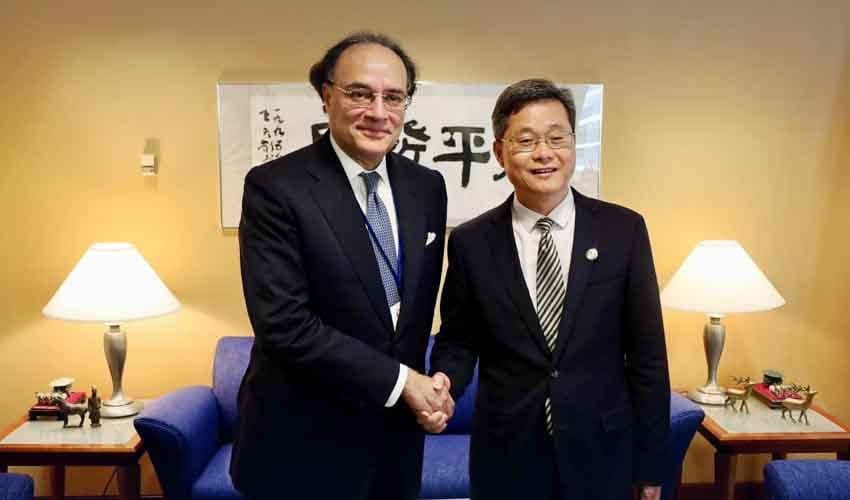
Aurangzeb met Chinese Finance Minister Lan Foan in Washington, where he thanked China for its long-standing and continuous support to Pakistan. He also appreciated the role played by China’s executive director at the IMF and briefed his counterpart on progress in Pakistan’s IMF program.
IMF progress and financial milestones
The finance minister shared that a staff-level agreement with the IMF has been completed, with final approval expected in early May. He also highlighted that Pakistan has successfully repaid a $1.4 billion Eurobond, while continuing to meet all creditor payments on time.
Additionally, Pakistan has received significant financial assistance from Saudi Arabia, which is helping strengthen the country’s external financial position.
Panda Bond, currency cooperation
Aurangzeb revealed that Pakistan is planning to issue its first Panda Bond, marking a key step toward accessing Chinese financial markets.
He noted that a large portion of trade between Pakistan and China is already being settled in Chinese currency, and emphasized the need to expand the currency swap facility to support growing trade activity.
Meeting with China’s central bank leadership
The finance minister also met the governor of the People's Bank of China, Pan Gongsheng, thanking him for China’s continued support at the IMF Executive Board. He updated the Chinese central bank chief on progress regarding the Panda Bond and requested early approval from the National Association of Financial Market Institutional Investors.
Gongsheng invited Aurangzeb to visit Beijing in the near future.
OPEC Fund for development
Aurangzeb held talks with Dr Abdul Hamid Al Khalifa, the chief executive officer of the OPEC Fund for International Development, on the sidelines of the World Bank–IMF Spring Meetings 2026, discussing ongoing and recently approved projects. He expressed interest in utilizing the OPEC Fund’s three financial facilities, including public sector loans, private sector financing, and Islamic finance.
The minister also invited the fund to increase private sector investment in Pakistan and stressed the importance of policy-linked budget support programs.
During discussions, Aurangzeb highlighted that water projects have become a national security priority for Pakistan. He added that environmental protection, food security, and digital transformation are closely aligned with the country’s development needs.
Outreach to global investors and institutions
At a JP Morgan seminar in Washington, the finance minister briefed global investors on Pakistan’s economic outlook. He assured that Pakistan will continue to meet its external payment obligations on time and said Saudi financial assistance is crucial for the planned Panda Bond issuance.
Aurangzeb also outlined a strategy to address the energy crisis, including targeted subsidies for vulnerable segments and demand management measures.
During a Q&A session, he addressed investor concerns regarding privatization and IMF support.
Meeting with Moody’s
The finance minister also met officials from Moody’s, where discussions focused on Pakistan’s return to global financial markets. He reaffirmed Pakistan’s commitment to continued engagement with the rating agency and shared updates on Eurobond repayments and financial discipline.
Aurangzeb said work is underway on issuing new bonds, including Euro bonds, as part of a broader strategy to access global markets. The minister emphasized securing supply chains in the energy sector as a top priority.
He also noted that increasing fertilizer reserves will support farmers and strengthen agricultural productivity.