Iran's Armed Forces have vowed a “heavy price” for Israel after confirming that the Zionist state carried out a series of early morning strikes on Iranian soil, targeting residential areas and senior officials, in what Tel Aviv described as “preemptive and precise” attacks.
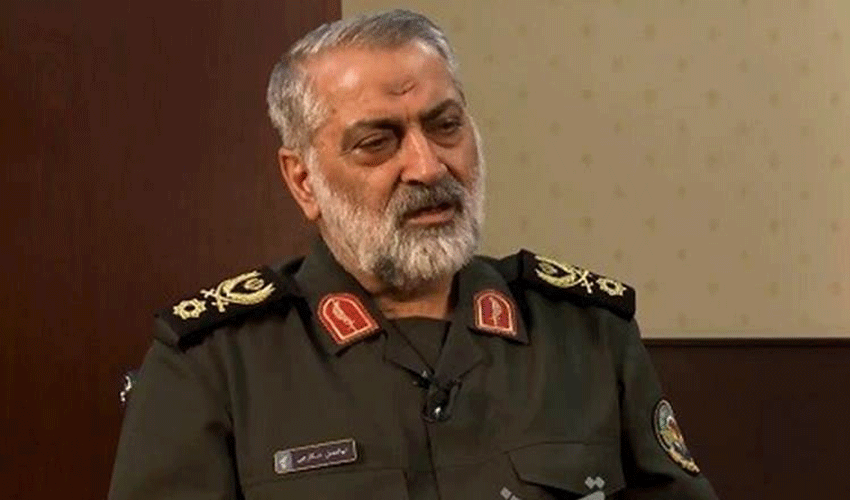
Brigadier General Abolfazl Shekarchi, spokesperson for the Iranian Armed Forces, told state television on Friday that the Islamic Republic is “fully prepared” for a retaliatory strike and will respond decisively to what he termed a “savage and calculated assault” supported by the United States.
“The Zionist enemy, with the assistance of the US, has launched a brutal attack on civilian homes and key officials’ residences,” General Shekarchi said.
“This reckless aggression has resulted in the martyrdom of several of our commanders and civilians. Israel has made a dire mistake and must now wait for a tough response.”
Iranian media, including IRIB and IRNA, reported that General Hossein Salami, the commander-in-chief of the Islamic Revolutionary Guard Corps (IRGC), was killed in one of the targeted attacks.
Though official confirmation is still awaited, multiple outlets have also named General Gholam Ali Rashid and prominent nuclear scientists Dr. Fereydoon Abbasi and Dr. Tehranchi among the possible casualties.
Explosions were reported in several parts of Tehran, with Iranian state media confirming significant damage to infrastructure. Images circulating on social media and shared by local news agencies showed destruction in residential neighbourhoods, fueling speculation that the attacks may have included targeted assassinations of senior figures.
In a statement shortly after the strikes, Israeli Defense Minister Israel Katz declared a state of emergency, warning of a potential missile and drone response from Iran.
“Following the State of Israel’s preemptive strike against Iran, a missile and drone attack against the State of Israel and its civilian population is expected in the immediate future,” Katz stated.
The Israeli military claimed the offensive had successfully hit “dozens of targets” related to Iran’s nuclear programme and long-range missile sites.
The attack comes amid mounting tensions between Tehran and Tel Aviv following months of covert operations, cyber-attacks, and cross-border proxy confrontations.
While Iranian government officials have yet to publicly comment on the details of the strikes, Shekarchi’s appearance on state television aimed to reassure the nation and send a signal to foreign adversaries.
“Our response will not be symbolic. It will be calculated, overwhelming, and will teach the enemy a lesson it will not forget,” he said.
The death of General Salami, if confirmed, would mark one of the most significant blows to Iran’s military leadership since the US assassination of IRGC Quds Force Commander Qassem Soleimani in 2020.
Salami, who took over the IRGC in 2019, was regarded as a central architect of Iran’s regional military strategy and a close ally of Supreme Leader Ayatollah Ali Khamenei.
The escalation has heightened fears of a broader regional war, with analysts warning of retaliatory attacks by Iranian allies, including Hezbollah in Lebanon and various armed groups in Iraq, Syria, and Yemen.
Videos shared online show extensive damage to apartment buildings and roads in Tehran, with emergency services reportedly working through the morning to assess the fallout. There has been no word yet from Iran’s Supreme National Security Council, though meetings are believed to be underway.
In recent weeks, tensions between Iran and Israel had been rising sharply over suspected sabotage attempts, covert assassinations, and hostile rhetoric. However, the scale and audacity of Friday’s strikes mark a dramatic new phase in the confrontation.
International observers are watching closely for Iran’s next move, amid concerns that the conflict could spill over into the broader Middle East, threatening oil routes and regional stability.

.jpg&w=256&q=75 "PML-N wins 9, PPP secures 4 seats in first phase of AJK elections")