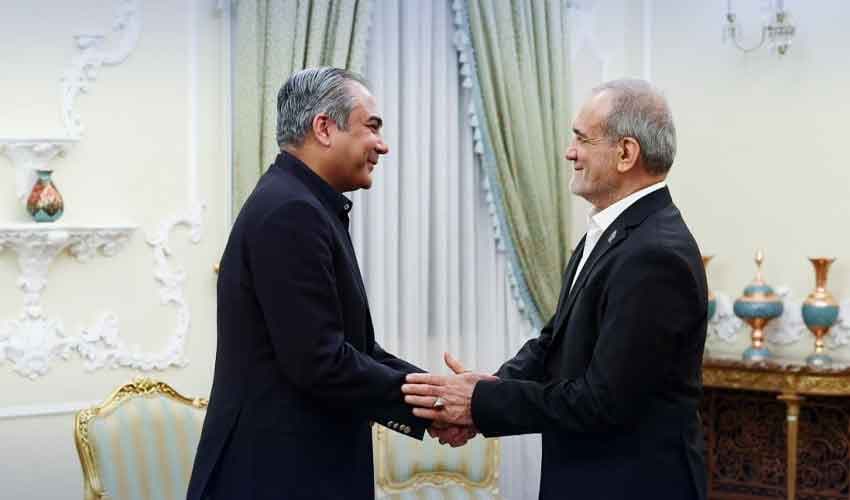
Interior Minister Mohsin Naqvi met Iranian President Masoud Pezeshkian and Foreign Minister Seyed Abbas Araghchi in Tehran on Tuesday, as Islamabad stepped up efforts to revive its mediation between the United States and Iran.
Naqvi also held meetings with Iranian Interior Minister Eskandar Momeni and Petroleum Minister Mohsen Paknejad during the visit, which comes amid renewed tensions between Washington and Tehran and a fragile situation around the Strait of Hormuz.
Naqvi arrived in Tehran on Tuesday and was received by his Iranian counterpart, Eskandar Momeni. He later held discussions with Momeni, Araghchi and other senior Iranian officials.
The mediation channel has remained largely dormant while Oman has taken the lead in negotiations concerning navigation through the Strait of Hormuz. However, reported progress in the Oman-Iran dialogue has created an opportunity for Islamabad to revive the broader process that emerged from the June agreement.
Pezeshkian calls for stronger Iran-Pakistan ties
During his meeting with Pezeshkian, Naqvi conveyed a special message from the prime minister of Pakistan and Field Marshal Asim Munir to the Iranian president, sources said.
They added that he also briefed the Iranian president on the Makkah Joint Defence Agreement and took him into confidence regarding the trilateral agreement.
Iranian media reported that Mohsin Naqvi is assisting Field Marshal Asim Munir in leading the peace talks. The field marshal has maintained continuous contact with officials from the Gulf countries, Iran and the United States, according to the Iranian media.
President Masoud Pezeshkian stressed Iran’s readiness to deepen relations with Pakistan in all areas of mutual interest.
The Iranian president highlighted the two countries’ longstanding historical, cultural and people-to-people ties and said Tehran highly valued the commitment of Pakistan’s leadership to strengthening solidarity and expanding bilateral relations.
Pezeshkian called for greater use of the existing capacities of both countries to expand economic, commercial, trade, cultural and security cooperation.
He said stronger bilateral relations would serve the mutual interests of Iran and Pakistan while also contributing to regional stability and security.
“The Islamic Republic of Iran is ready to further deepen its relations with Pakistan in all areas of interest to the two countries and to pave the way for the development of joint cooperation,” Pezeshkian said, according to Iranian state media.
The Iranian president also emphasized that closer engagement between Tehran and Islamabad was important in the broader regional context, particularly at a time of heightened tensions.
Implementation of existing agreements
Naqvi said his visit was aimed at following up on agreements and understandings reached during Iranian Interior Minister Eskandar Momeni’s recent visit to Pakistan.
The minister described relations between the two neighbours as “strong, long-standing and unbreakable” and conveyed Islamabad’s serious determination to pursue the comprehensive development of ties with Tehran.
Naqvi also stressed the need to operationalize existing bilateral agreements rather than allowing them to remain on paper.
He said the visit was part of efforts to strengthen cooperation mechanisms and accelerate implementation of commitments already reached between the two countries.
Meeting with Iran’s foreign minister
Naqvi also met Iranian Foreign Minister Abbas Araghchi, with Iranian state media reporting that the two sides discussed key diplomatic issues and bilateral relations.
The meeting assumes particular importance as Pakistan seeks to maintain its communication channel with Tehran while encouraging dialogue between Iran and Washington.
Pakistan had recently invited Araghchi and Iranian parliament speaker and chief negotiator Bagher Ghalibaf to visit Islamabad at the “earliest possible opportunity.”
Iranian Foreign Ministry spokesman Esmaeil Baghaei said on Monday, however, that the visit by the two Iranian officials would take place “at an appropriate time.”
Naqvi’s trip therefore represents an effort by Islamabad to keep its mediation channel active instead of waiting for the Iranian leadership to travel to Pakistan.
Pakistan seeks to revive stalled Islamabad MoU
The Persian Gulf, particularly the Strait of Hormuz, remains in a fragile “no war, no peace” situation following the collapse or stalling of the Islamabad MoU reached between Iran and the United States in June.
Pakistan is now looking for an opportunity to revive the wider diplomatic process that followed that agreement.
Pakistani officials said Tuesday that Washington and Tehran were close to reaching “some sort” of agreement, although the two sides continue to exchange messages through intermediaries rather than negotiating directly.
Pakistan, alongside Qatar, has been involved in mediating between the United States and Iran.
US-Iran tensions continue
Naqvi’s visit comes amid renewed hostilities between Washington and Tehran. Fighting had briefly stopped in June after Pakistan brokered a peace deal between the two sides, but tensions escalated again last month after Washington accused Tehran of attacking commercial ships in the Strait of Hormuz.
US President Donald Trump said on Monday that he would seek conflict compensation from Iran as part of any peace negotiations. Trump cited attacks and killings over several decades that he alleged were backed or perpetrated by Tehran.
The Iranian position has been that US payment of war reparations is a precondition for resolving the ongoing hostilities.
The developments have placed the Strait of Hormuz and the wider Persian Gulf at the centre of international diplomatic efforts to prevent another escalation.
Energy and trade cooperation also discussed
During his Tehran visit, Naqvi met Iranian Petroleum Minister Mohsen Paknejad to discuss bilateral cooperation in trade and energy.
Paknejad said there were several areas where Iran and Pakistan could expand cooperation, particularly in petroleum and oil-products trade and the export of technical and engineering services.
He specifically highlighted opportunities in the refining sector.
The discussions add an economic dimension to Naqvi’s diplomatic mission, with both countries seeking to strengthen practical cooperation alongside their political and security engagement.
Pakistan’s wider mediation role
Naqvi, Prime Minister Shehbaz Sharif and Chief of Defense Forces Field Marshal Syed Asim Munir have been closely involved in discussions with Iranian leadership as Islamabad attempts to help end the conflict.
Naqvi has visited Iran several times in recent months and held meetings with the country’s leadership as Pakistan has sought to position itself as a regional mediator.
Pakistan has played a key role in mediation efforts since the US-Iran war began in February. Islamabad brokered a ceasefire between the two sides in April and hosted the first round of direct peace talks between Washington and Tehran later that month.
The Pakistani government has repeatedly urged all sides to exercise restraint and maintained that dialogue is the only viable route to preventing the conflict from expanding into a wider regional confrontation.
With the Oman-Iran dialogue reportedly making progress and Pakistani officials suggesting that Washington and Tehran may be nearing an understanding, Islamabad is now attempting to reactivate its own diplomatic channel and turn previous agreements into a broader peace process.