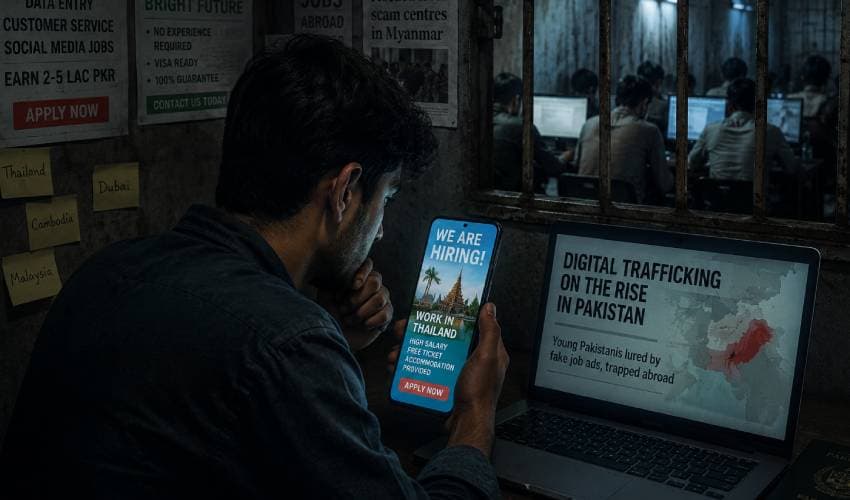
Pakistanis are being lured into Southeast Asia's scam compounds, defrauded by those same operations at home, and now recruited to run them from Pakistani soil. Against all three fronts the state is losing, and the clearest measure of the defeat is a single pair of numbers: in the first five months of 2026, Pakistan logged more than 77,000 cybercrime complaints and secured eight convictions.
For eight days in February 2025, fourteen Pakistani men sat in a walled detention camp in Myawaddy, on Myanmar's border with Thailand, watching other nationalities go home. They had been freed from a scam compound where they were forced to defraud strangers online, and now they were stuck again, in a shelter with a roof but no walls. One of them, hoping to be back before Ramadan, put the question to a news agency plainly: they were safe now, so why could they not leave? He said he felt abandoned by his own government.
He was not wrong to feel it, and he was far from alone. His story is the visible tip of a problem most reporting treats as a foreign one, happening safely far away in Myanmar. It is not far away. Pakistan is entangled in the global scam economy from three directions at once, and the same weakness runs through all three.
Front one: the citizens who are taken
The recruitment begins the way it always does now, on a screen. Fraudulent job ads promising well-paid work abroad circulate on Facebook, TikTok and WhatsApp, and the International Centre for Migration Policy Development, which studied the problem in Pakistan through 2025, describes agents who collect fees and passports and then hand over only a tourist visa, dropping the recruit into an irregular status the moment he lands. The destination, increasingly, is a compound.
More than 500 Pakistanis have been documented forced into cybercrime inside Myanmar's scam centres, according to reporting relayed to Pakistan's Senate. What happened next exposed the state's real capacity to protect them. Pakistan's High Commissioner in Thailand told a visiting deputy Senate chairman that the embassy was working to evacuate imprisoned Pakistanis but was hampered by financial constraints, even as other governments moved their nationals out faster. A citizen trafficked abroad discovers, at the worst possible moment, how thin the safety net behind him really is.
Front two: the citizens who are cheated
The same machinery that recruits Pakistanis also robs them. Financial fraud is now the largest single category of cybercrime reported in the country, with 81,996 such complaints filed in 2025 alone, alongside thousands of hacked WhatsApp accounts used to run scams through a victim's own contact list. Digital-rights researchers documented "honey trap" schemes in early 2026 that lured Pakistani freelancers with fake job offers and then extorted them.
What is changing is the tooling. A UN Office on Drugs and Crime brief in late 2025 documented criminal groups in the region deploying AI-generated deepfakes, voice cloning and multilingual chatbots to make fraud more convincing and more scalable, and Pakistan amended its Prevention of Electronic Crimes Act in 2025 specifically to address deepfakes. The cruelty compounds: some of the trafficked workers in the compounds are forced to serve as the human faces behind AI-driven video calls, meaning a Pakistani victim abroad can be made into the instrument that defrauds a Pakistani victim at home.
Front three: the compounds on Pakistani soil
The most overlooked front is domestic. The scam operation is no longer only something Pakistanis are exported into; it is something now run from inside the country. In July 2025, investigators raided a compound in Faisalabad and arrested 149 people, among them dozens of foreign nationals alongside Pakistanis, who were allegedly running large-scale online fraud, hacking and investment scams from Pakistani ground. The pipeline has, in other words, started to loop back home.
The state that cannot land a blow
Set against all three fronts is an enforcement system that produces motion without result.
The figures Pakistan's own interior ministry presented to the National Assembly tell the story without editorial help. Of the 77,023 cybercrime complaints filed in the first five months of 2026, most were filtered out at verification, a fraction became formal inquiries, fewer still became registered cases, and only eight ended in a conviction. This is not a one-year stumble. It is a slide.
Convictions have fallen from 92 in 2023 to 60 in 2024, 39 in 2025 and just eight so far in 2026, even as annual complaints stayed above 150,000. The government has not been idle on paper: in 2024 and 2025 it replaced the FIA's Cyber Crime Wing with a new National Cyber Crime Investigation Agency, gave it forensic laboratories and helpline 1799, and amended PECA. The machinery exists. It simply does not convict.
Part of the reason is that the watchdog has been compromised from within. In late 2025 the NCCIA was engulfed in a corruption scandal in which some of its own officers were found taking roughly 15 million rupees a month from around 15 illegal call centres, mostly foreign-run, in Rawalpindi and Islamabad, in exchange for letting the scam operations continue. The agency's director general was changed as the scandal widened. An institution paid to shut the compounds down was instead being paid to keep them open.
A law pointed the wrong way
There is a second reason the convictions do not come, and it is uncomfortable for a government to hear. Critics, including the newspaper Dawn, have argued that PECA is applied unevenly: financial-fraud cases stall in the system, while the law is far more visibly and energetically deployed against online speech, journalists and dissent. A statute sold to the public as protection against scammers has become, in practice, more reliable at policing critics than at catching criminals. For the jobseeker staring at a fraudulent ad, the state's most active digital law is not the one guarding his savings.
The platforms, for their part, act at a distance. Meta says it removed 159 million scam ads in 2025 and disabled millions of accounts linked to scam centres, but that enforcement happens far above the head of a young man in Faisalabad or Jhang, and it does nothing to change whether his own government can convict the recruiter who took his money. The protection that would actually reach him is domestic, and it is failing.
The verdict
The through-line across all three fronts is the same: not an absence of laws, agencies or announcements, but an absence of will and integrity in using them. Pakistan has a cyber agency, a forensic lab, a helpline, a register of licensed recruiters and a freshly amended law. It also has eight convictions, a bribery scandal inside the very agency meant to lead the fight, and an embassy that cannot afford to bring its trafficked citizens home.
Those facts are not separate. A state that cannot convict the scammer operating openly on its own soil will not summon the resolve or the resources to rescue the citizen trapped in a compound abroad, and the recruiters know it. Until the convictions become real, the watchdog is cleaned out, and the trapped are actually brought home, the fraudulent ad in the feed remains the safest bet in the country. The eight convictions are not a statistic. They are the answer to the fourteen men in Myawaddy who asked why no one was coming for them.
Reporting note: figures are drawn from disclosures by Pakistan's interior ministry to the National Assembly (2026); the National Cyber Crime Investigation Agency; ICMPD (2025); the UN Office on Drugs and Crime; Meta's public disclosures; and reporting by The News, Geo, The Express Tribune, Dawn, Journalism Pakistan, Minute Mirror and Wikipedia's compilation of NCCIA records. Any quote carried from another outlet must be verified against the original before it runs.