It begins with a debt after a flood and ends in a locked scam compound on the Myanmar border. This is the pipeline that carries Pakistan's climate-displaced men from a drowned field to forced labour abroad, one step at a time, and why almost no one is waiting for them at either end.
The water always goes down eventually. What it leaves behind is what the recruiter is counting on: a collapsed house, a dead buffalo, a field of salt where the wheat used to be, and a debt to the landlord that has quietly doubled.
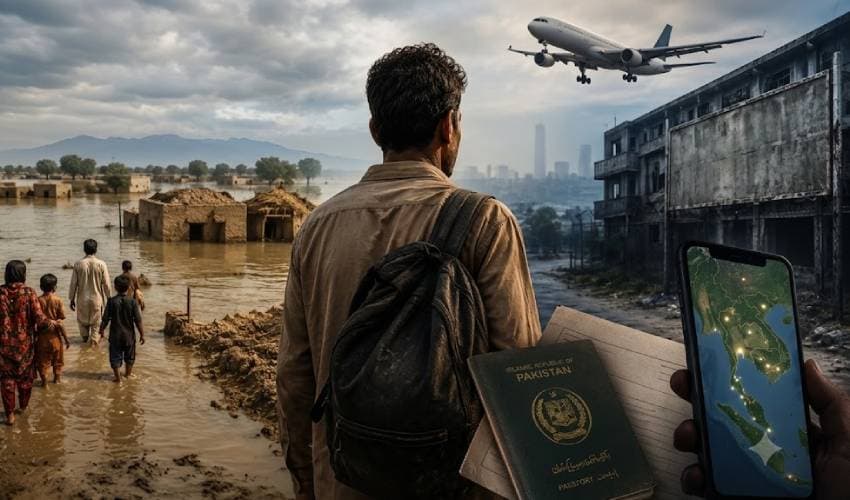
In the riverine belts of Sindh and southern Punjab, the man who comes with the offer is rarely a stranger. He knows whose crop failed, who buried a relative last monsoon, which family borrowed to rebuild and cannot keep up. He arrives with a photograph on his phone: a clean office in Bangkok, a salary in dollars, a way out. What he does not show is the road that offer actually travels, which does not end in an office in Bangkok. It ends behind a wall on the Thai-Myanmar border, where the man who took the job is made to sit at a screen and defraud strangers until he is allowed, if he is allowed, to leave.
This is the part that is almost never reported as a single story: that Pakistan's climate crisis and Southeast Asia's trafficking crisis are joined end to end, and that the flood is the first link in the chain.
The flood is the opening move
To understand why the pitch works, start with the size of the hole the climate keeps digging.
The 2022 super-floods were among the worst disasters in Pakistan's history. According to the World Bank's Post-Disaster Needs Assessment, they affected 33 million people, caused more than $14.9 billion in damage and $15.2 billion in economic losses, and destroyed or damaged over two million homes. Nearly eight million people were displaced, and the assessment warned the disaster could push between 8.4 and 9.1 million more Pakistanis below the poverty line. Sindh alone accounted for close to 70 percent of the total damages and losses. Then it happened again: the 2025 monsoon displaced about 3.5 million people, according to UN OCHA, while the UN Development Programme reported more than six million affected and over a thousand dead.
A flood is usually reported as an event, with a beginning and an end. But for the households in its path, each flood empties the same villages and refills the same reservoir of desperation: people with no land to return to, no crop to harvest, and a debt that grows with interest. That reservoir is exactly what the traffickers fish in, and they know precisely when the fishing is best.
The offer, and the machinery behind it
The recruiter is the first link, and he is deliberately familiar. Investigations across South Asia find that these networks usually begin with local recruiters who are friends and neighbours, before widening into organised syndicates that move people with forged documents and the help of complicit officials. The pitch is a job abroad, in Thailand, Malaysia or the Gulf, with travel and accommodation arranged. The reality, the International Centre for Migration Policy Development reports, is that agents collect fees and passports and then supply only a tourist or visit visa, quietly turning a legal traveller into an undocumented one the moment he lands.
Increasingly, the first contact is a screen. Fraudulent job ads on Facebook, TikTok and WhatsApp have become a primary gateway, and the strain shows in law enforcement's own files: of 187 forensic analysis requests handled by the FIA's Cybercrime Cell in 2022, 115 were tied to migrant smuggling and human trafficking.
The rot reaches inside the state itself. On New Year's Day 2025 the FIA announced it had dismissed 35 of its own officers, and later arrested 13, for complicity in trafficking, after a boat carrying mostly Pakistani migrants from Libya capsized off the Greek island of Gavdos. The officers had worked exit points at airports in Lahore, Islamabad, Faisalabad, Sialkot and Quetta. A safeguard that could catch many frauds already exists and is barely used: the Bureau of Emigration's public register of licensed recruiters, which as of March 2026 listed 5,199 licences, of which only 2,672 were active. A jobseeker who checked the glossy offer against that list would catch a great many of the fakes in seconds. Almost none do.
The route to the wall
The journey follows a consistent path. The recruit flies out on his tourist visa, often to Bangkok, then travels overland toward Mae Sot on Thailand's western edge, a town that has become the main crossing point and, now, the main site of mass repatriations. From there he is taken across the Moei river into Myawaddy in Myanmar's Kayin State, into a landscape of fortified compounds with names that recur in every account: KK Park, Shwe Kokko. The compounds are largely run by Chinese criminal syndicates and physically protected by ethnic militias. The head of one of them, the Karen Border Guard Force commander Saw Chit Thu, has been sanctioned by the European Union and the United Kingdom for profiting from the compounds and from human trafficking.
Once inside, the passport is gone and the tourist visa is worthless. The recruit is no longer a migrant worker. He is inventory.
Inside the compound
What happens next has been documented in unusual detail, because so many survivors have now escaped to tell it.
The work is fraud, industrialised. Trafficked workers are forced to run "pig-butchering" schemes, elaborate romance and fake-investment cons, along with crypto and online-gambling frauds, against victims around the world, an industry the UN Office on Drugs and Crime estimates drained between $18 billion and $37 billion from Asia in 2023 alone. Survivors describe shifts of up to 17 hours, daily targets, food deprivation and no medical care. Those who miss quotas, refuse to scam or try to escape are punished. A UN human rights report catalogued beatings, electric shocks, sexual violence, forced abortions, solitary confinement and even threats of organ harvesting, a litany the UN rights chief called staggering. Workers who fail to perform are sometimes simply sold on to another compound.
Pakistanis are inside these walls. When a multinational crackdown began freeing people in early 2025, Thailand's army said the first group of around 260 released from Myawaddy came from 20 nationalities, with significant numbers from Pakistan among them. Pakistani nationals were also named among those documented as tortured in the compounds. One trapped Pakistani man told the Associated Press his passport had been confiscated and that everything was "like hell, a living hell." A researcher documented the case of a Pakistani who refused to scam and secretly texted his intended victims for help; a supervisor reported him, and guards used electroshock batons on him.
The scale is enormous and the response is lagging. The Guardian reported in 2025 that Myanmar's scam centres may hold as many as 100,000 trafficked people. Since early 2025 more than 5,200 people have been extricated from Myawaddy facilities and over 3,500 repatriated through Thailand, and Myanmar's authorities claim more than 70,000 foreign nationals have been sent home to 54 countries over two years. Yet a rights group reported that more than 5,300 people were still trapped as of June 2026. Repatriation stalls precisely where a home government is slow to claim its citizens, and Pakistan's own record on how many of its nationals have been trapped, freed and brought home remains largely unexamined.
The loop closes
The cruelty has a business logic, and it is the reason the pipeline sustains itself. Because forced labour is what makes a compound profitable, the surest way for a trapped worker to buy his freedom is to bring in someone to replace him. Survivor accounts consistently describe this pressure to recruit. The victim becomes the next recruiter, and the most persuasive recruiter of all, because he is a real person from the same district who really did go abroad. He comes home, carrying a debt and a story he cannot fully tell, and when the next flood empties the next village, he is the trusted face behind the next offer. That is how a crime that looks like distant news in Myanmar keeps its roots in a Pakistani floodplain.
The floor beneath it all
The compound is the extreme end of a much larger domestic baseline. Walk Free's Global Slavery Index estimates that around 2.3 million people in Pakistan were living in modern slavery, including forced labour and debt bondage, one of the highest absolute totals of any country on earth, and it links climate shocks directly to the displacement and poverty that feed exploitation. The flood does not spare those who never board a plane, either. The UNDP found that after the 2025 floods one Sindh village alone reported 45 child marriages in a year, an 18 percent spike, with more than 640,000 adolescent girls at heightened risk, while the FIA has broken up networks luring women abroad with fake jobs, in one case rescuing nearly 33 women bound for Dubai.
What breaks the chain
If climate disaster is the supply line, then the response cannot begin at the airport departure gate. It has to begin in the floodplain and follow the same route the victim does.
Prevention starts with the debt. Treating climate-resilient livelihoods and debt relief as anti-trafficking measures, rather than as disaster charity, attacks the leverage the recruiter depends on. Rights advocates argue that Pakistan, among the countries least responsible for and most exposed to warming, is a strong candidate for debt relief as a form of climate reparation, money that could keep a sharecropping family off the recruiter's list after a bad season.
The pipeline itself must be cleaned. That means finishing the job the FIA started against its own complicit officers, turning the Bureau of Emigration's licence register into something a worker can check on the same phone the ad arrived on, and pursuing the agents rather than only the desperate people they sell.
Crucially, the men who come home must be treated as victims, not criminals. A returnee who was forced to scam under threat of electric shock is a trafficking survivor, and prosecuting or shaming him only strengthens the traffickers' grip on the next recruit. Faster consular action to claim and repatriate trapped Pakistanis belongs in the same category of duty.
And then there is the channel that reaches these villages more reliably than any government portal: the mosque, the local elder, the Friday sermon. If recruiters exploit community trust to lure people in, the same trusted networks can be equipped to warn them out. It is a counter-messaging system hiding in plain sight, and one still largely absent from Pakistan's response.
The flood will come again; the science leaves little doubt of that. The question this story asks is whether, when the water next recedes, the recruiter is still the first person to reach the people it left behind, or whether someone finally gets there first.
Reporting note: figures are drawn from the World Bank Post-Disaster Needs Assessment (2022); UN OCHA and UNDP (2025); Walk Free's Global Slavery Index 2023; the UN Office on Drugs and Crime, cited via ICMPD (2025); Pakistan's FIA; UN human rights reporting; and survivor testimony and rescue data documented by the Associated Press, Radio Free Asia, NPR, The Guardian, OCCRP, Al Jazeera, The Conversation and The Diplomat. Any quote carried from another outlet must be verified against the original before it runs.