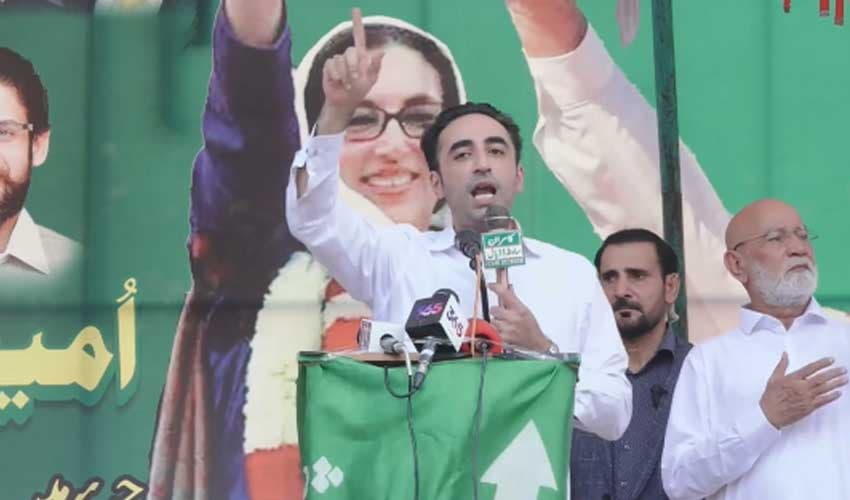
Pakistan Peoples Party (PPP) Chairman Bilawal Bhutto-Zardari said on Friday that the youth would decide the fate of Azad Jammu and Kashmir (AJK).
Addressing an election rally in Dadyal, the former foreign minister criticised his political opponents. He said the PPP would defeat the "lion" and questioned why Dadyal and Kotli had been erased from the map of AJK. He also alleged that another political party did not recognise Mirpur, Kotli and Rawalakot as part of AJK.
Bhutto-Zardari said the current election was the most important in Kashmir's history. He said the decision on Kashmir rested with its people, particularly the younger generation.
He said the PPP had defeated the politics of hatred and division in Karachi, Balochistan and Khyber Pakhtunkhwa and would do the same in AJK on July 27.
The PPP chairman said his party had always presented a public-friendly manifesto and worked for poorer people. He said two million houses were being built for flood-affected families in Sindh and that women were being given property ownership rights.
Bhutto-Zardari said the PPP would convene constitutional conventions in Azad Jammu and Kashmir and Gilgit-Baltistan. He said constitution-making should take place through parliament rather than on the streets.
He said the PPP could secure the right of self-governance for Azad Jammu and Kashmir and would continue its struggle on the Kashmir issue.
Referring to Gilgit-Baltistan, Bilawal said the PPP had broken the tradition under which the party in power at the centre also formed the government there. He said the people of Gilgit-Baltistan had given the PPP a clear majority for the first time.
He also commented on the situation in Kashmir, calling for a Truth and Reconciliation Commission. He said protests should remain suspended until such a commission completed its work. He urged both the authorities and protesters to leave enough room for ordinary Kashmiris not to suffer.
Bhutto-Zardari said action should be taken only against those involved in terrorism and theft, and not against people who had committed no offence. He urged the government to explain its policy and said that if his proposal was not acceptable, an alternative solution should be presented.