In Pakistan, labour migration has become a silent necessity that has become part of countless family narratives. According to the Bureau of Emigration and Overseas Employment, more than 762,000 Pakistanis left the country for overseas employment last year alone, adding to the $38.3 billion remittances that have upheld the national economy. These numbers, however, cover a lesser-known truth: the emotional cost paid by families left behind.
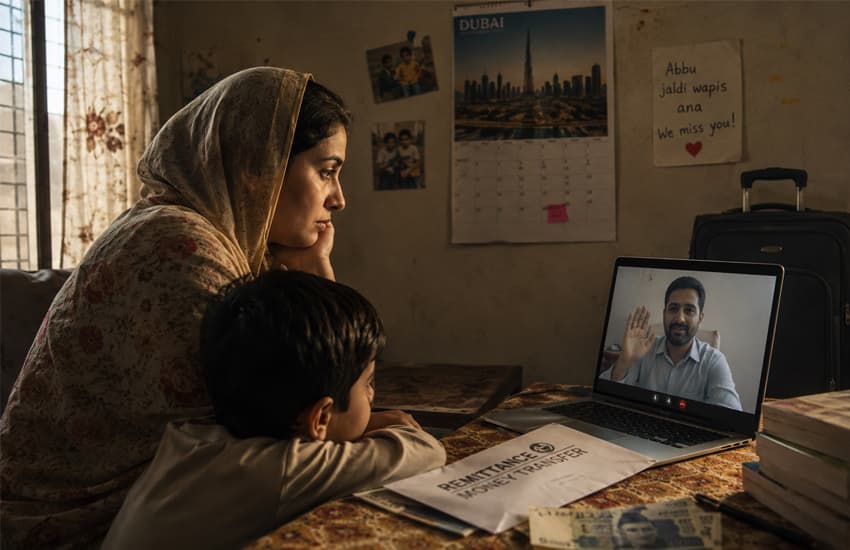
Behind every transfer receipt and remittance figure lies a story of separation of spouses living apart for years, children talking to their fathers only through a screen, and women managing entire households while carrying mental load and the deeply draining emotional work of maintaining relationships.
Through conversations with women whose husbands work abroad, the complex reality of migration begins to unfold: one of pride mixed with pain, of comfort exchanged for connection, and of strength constantly tested by distance.
‘Mehka To Susral’
When Fariha Yasir, 40, got married 17 years ago, she did not imagine her wedding would lead directly into long-term separation. “Ghar se ghar tak ka safar (journey from one home to another),” she recalls with a soft laugh, the journey from her mother’s home to her in-laws’. But that journey soon extended much farther. Her husband, working in IT, had to leave for Dubai barely a month after their wedding.
The honeymoon period ended in silence. “He had gone to fulfil our needs,” she says. “But I didn’t get a chance to travel or even go out with him.” She was surrounded by relatives in a joint family, but emotionally alone.
Their connection existed through Skype calls in those early years before social media. “I would wait all day just to hear him calling,” she remembers. “But when I finally picked up, he’d get calls from customers at work. Hours would pass like that, with me waiting on the other side of the phone just to talk to him properly for a few minutes.”
This remained their routine for years, a few moments of conversation, waiting for hours just to hear from each other again. Even now, with WhatsApp video calls replacing pixelated Skype screens, she feels the same ache during Fajr and Tahajjud prayers, the quiet hours that once used to be their time together. This is when she misses him the most and feels his absence in every second of that time.
Her husband now visits every six months for a month-long stay, but each time he leaves, “my children and I have to relearn how to live without him, as if for a moment we forget that he will not be staying with us forever.” Her sons are particularly attached to their father; an attachment shaped by distance.
“People think wives of men abroad live comfortable lives,” she says, “but they don’t see how lonely it can be.”
For Fariha, the question remains unresolved: is it better to earn well abroad and live apart, or to stay together and live with less? “Enjoy less luxuries, eat less, but stay together,” she tells him, her belief steady.
‘Parhi Likhi Bahu’
While Fariha’s story reflects quiet endurance within a loving marriage, Nimra Abid, 28, represents a harsher reality, one where migration left one partner carrying the emotional and household burden mostly on their own.
Nimra has been married for four years. Her husband, Usman, has worked abroad for nearly a decade. When he left, she was pursuing her MS degree, the only educated daughter-in-law in a joint family of 22 members.
“They made it impossible to go to university,” she said. “I was forced to give tuition to their kids, cook, do the dishes, do laundry, etc, all under the label of parhi likhi bahu hai, sab kuch karna parega ([she is] an educated daughter-in-law, [and] would have to do everything).”
Her freedom from dressing to visiting her parents was tightly controlled. A simple act like ordering an Eid dress online turned into disgrace. “They said, ‘Why is an unknown man delivering your clothes?’” she recalls bitterly. “I had no freedom of movement, no voice, as if whatever I said never mattered to anyone.”
Living in a rural area with limited hospitals or basic facilities, her husband’s physical absence became far more challenging than just the emotional aspect. “Even for something as basic as going to the market or getting medical help, I had to rely on others for everything,” she said. “It felt suffocating that even the small daily tasks were a reminder of how helpless, alone and dependent I was every day.”
Communication, which many imagine as a source of comfort and solution to most of the problems, initially brought her more pain. “Every call turned into a fight,” Nimra said. “He didn’t believe me when I told him how bad it was. He thought his family was perfect, and the conversation would go nowhere, which would only make me more frustrated at him.”
Only when Nimra spent two months abroad with him did her husband understand and begin to see her struggles more clearly.
It took years of quiet tolerance for her to regain her self-respect. “Crying was the only coping mechanism at first,” she said. “But then I learned to defend myself, to make them stop shouting, and set boundaries.”
Now, she has found herself engaging in activities like exercising, sketching and painting. When the house finally settles down, she can enjoy her “me” time. But even through those peaceful moments, there’s one thing she still longs for; which is her husband just by her side.
“I just want a home where I am free, where it’s me, my husband, and our children, without fights and restrictions,” she said.
Invisible Labour, Visible Pain
Both women’s experiences reflect a broader, largely unseen reality faced by thousands of Pakistani wives in cross-border marriages. Sociologists sometimes describe this phenomenon as “emotional remittance”: the emotional burden families carry in exchange for financial support.
Unlike the men’s structured work schedules abroad, women’s emotional work never ends. From managing finances to parenting solo and performing the role of daughter-in-law under observation, their labour fills every space that absence leaves behind.
“Distance changes family architecture,” observes Dr Hira Saeed, a Lahore-based psychologist who has worked with spouses of overseas workers. “Many of these women live in joint families where privacy or emotional openness isn’t encouraged. So, grief and loneliness turn inwards, often manifesting as anxiety, guilt, or somatic pain, headaches, fatigue, and sleep disturbance.”
She noted that even when parents or in-laws are well-meaning, the unspoken expectation that women must “endure quietly” takes a psychological toll. “The more the community praises their sacrifice, the harder it becomes for them to express emotional needs without guilt.”
Men, too, are caught in the conflict. Many carry immense pressure as sole earners supporting multiple relatives and taking their responsibility. Their emotional lives diminish under the weight of responsibility, leaving attachment and understanding to fade behind screens and time zones.
“Elongated migration blurs emotional intimacy,” Dr Saeed explains. “When communication is limited to phone updates about money, bills, or chores, affection gets displaced. Over years, marriages can start to resemble contractual partnerships rather than emotional ones.
Digital Fatherhood
Both Fariha and Nimra spoke of how their children’s relationships with their fathers have been shaped almost entirely online. Fariha’s sons, for example, are deeply attached to their father despite rarely seeing him, driven by longing.
Psychologists say many migrant families now experience a form of “digital fatherhood,” where children grow emotionally attached through screens rather than physical presence. “Children develop affection through shared activities, touch, and co-regulation,” says Dr Saeed. “When contact is reduced to calls and video chats, it creates what we call ambivalent attachment: love mixed with confusion and insecurity.”
Over time, these children may idealise the absent parent or, on the other hand, grow distant when they realise that love expressed through screens lacks immediacy.
Mothers, meanwhile, carry the heavy emotional burden of both parenting roles, the nurturer and the disciplinarian, all while navigating extended family power dynamics.
The Joint Family Paradox
Both women highlight the mixed feelings of Pakistan’s joint family system, once seen as a safety net, now often an emotional rollercoaster.
For Fariha, the joint family offered stability and company in her husband’s absence. For Nimra, it became a site of control and conflict. Their stories show a growing sociological split: while older generations see joint family system as a mark of togetherness, younger women increasingly view it as a barrier to independence, especially when their husbands are not around.
“In joint systems, emotional transparency is discouraged,” says Dr Saeed. “Women suppress their feelings, fearing they’ll be labelled ungrateful or self-centred. This suppression can lead to cumulative emotional exhaustion what we clinically term adaptive fatigue.”
A Generation Redefining ‘Sacrifice’
Despite enduring different circumstances, both Fariha and Nimra join on one shared wish: togetherness. “Either he calls us there,” Fariha says, “or comes here to live with us. We need to stay together. That’s what the children want too.”
Nimra mirrors that craving. “People say living abroad makes life easier, but it costs your peace of mind.”
Their voices highlight a shift in how a new generation of Pakistani women perceives “sacrifice.” Unlike their mothers, who often normalise separation as part of marital duty, many young wives now speak about the emotional toll, openly demanding not empathy but recognition.
Dr Saeed sees this as a positive evolution. “Women are beginning to name the pain that society once dismissed as normal. That’s the first step toward healthier communication, not just between couples but across generations.”
What The Numbers Don’t Show
Remittances sustain countless families and strengthen Pakistan’s foreign reserves. Yet, they also generate a quiet paradox: economic gain built on emotional separation.
When migration becomes a long-term substitute for development within one’s own country, it transforms not just individuals but entire family systems. It restructures love into systematic cooperation with each other, replaces presence with performance, and turns resilience into routine.
As Fariha says, “He works day and night to keep us happy and forgets about his own happiness.”
This is the unseen reality of migration: in one way, financial stability; in the other, emotional debt.
What Families Are Really Paying
Pakistan’s migrant success story cannot be told only in billions remitted or homes built anew. It must also be told in waiting hearts, in prayers whispered at dawn, in mothers who raise children alone yet never call themselves single parents, in children who just want the comfort of their parent’s arms and nothing else, and in wives who don’t crave luxuries or better lifestyle but just their partner to be by their side.
These women are the quiet supports of a globalised economy, holding their worlds together with all they have from thousands of miles apart.
“Mere masroof lamho mein shamil hai teri yaadein,” Fariha said, “Your memories live within my busy moments.”