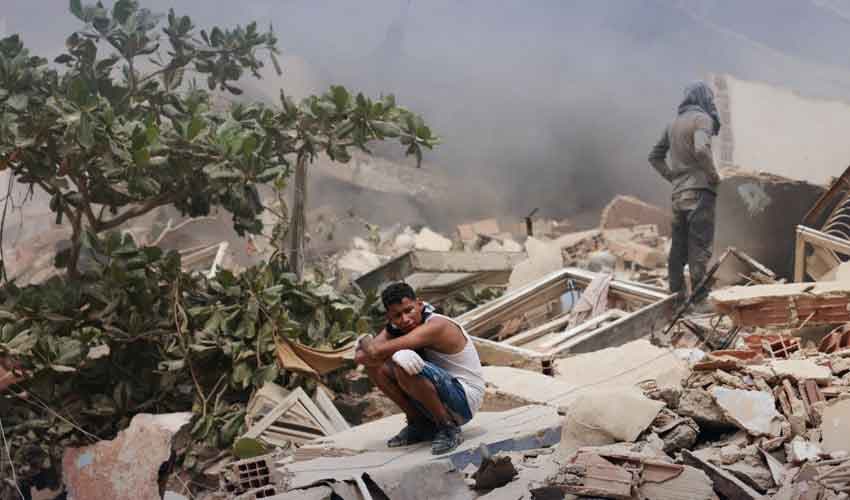
The death toll from the twin earthquakes that struck the country has climbed to 920, while over 3,000 people have been injured.
Speaking early on Friday alongside senior government and military officials, Acting President Rodríguez welcomed international rescue teams arriving to assist with relief efforts. She vowed that authorities would continue searching for survivors trapped beneath the rubble.
“We are going to rescue the people who are trapped,” she said. “We are working tirelessly on this task.”
Rodríguez identified La Guaira as the worst-affected state following the 7.2- and 7.5-magnitude earthquakes that hit on Wednesday evening. She said the area has been placed under military control to support ongoing search-and-rescue operations and the distribution of food and drinking water.
Authorities warned that the death toll is likely to rise further as thousands of people remain missing and rescue operations continue.
The International Organization for Migration (IOM) estimates that as many as 6.76 million people across Venezuela may have been affected by the earthquakes, including around 2 million residents in Caracas.
State television showed injured survivors, including children, being pulled from collapsed buildings covered in dust and blood. In one dramatic rescue, emergency workers freed a woman trapped beneath a concrete slab, with only one of her feet visible before she was safely pulled out alive.
Despite the ongoing rescue efforts, reports indicated that only a limited number of government search teams were initially deployed outside the capital, Caracas.
The disaster hit a country already weakened by years of economic turmoil, which left much of its infrastructure fragile and complicated rescue efforts as aftershocks rattled the capital and surrounding coastal areas.
Jorge Rodriguez, head of Venezuela's national assembly and brother of interim President Delcy Rodriguez, said earlier in the day that 200 people had been trapped, with 250 buildings damaged or destroyed.
At least eight hospitals, the headquarters of the Venezuelan Red Cross and the French embassy were among buildings reported to have been badly damaged.
Interior Minister Diosdado Cabello said some 70,000 families in La Guaira state had been affected.
'Disaster zone'
La Guaira, the coastal state adjoining Caracas and home to the capital's main airport, was among the hardest-hit areas.
"It has become a disaster zone," acting President Rodriguez said, adding that the government was working with private companies to bring in heavy equipment and speed up rescues.
Electricity remained scarce in parts of the state, while the Caracas airport was closed after suffering damage. Witness videos from the terminal showed scenes of panic as ceiling panels crashed down.
Emergency workers and volunteers searched through collapsed buildings into the night. But in some areas, residents said official help had been slow to arrive.
Yamileth Jimenez, a resident of La Guaira city, said her 19-year-old son was still trapped in the debris of their seven-story apartment building.
Also Read: Venezuela earthquakes kill 188, injure 1,520 as rescue efforts intensify
"He's under the slabs and there's no machinery to get him out," said Jimenez, whose father died three days earlier.
In La Guaira city, volunteers dug through wreckage with their bare hands as families waited for news of missing relatives. Along the Caracas-La Guaira highway, streams of civilians headed toward the coast carrying water, food and medicine, stepping in as the scale of the disaster overwhelmed initial rescue efforts.
"We lost everything. We have no food or medicines ... We hope help arrives quickly," said Pedro Perez, 64, an upholstery workshop owner who said he had lost both his home and business and was sleeping on the street with his wife and children.
Residents rush outside
Many Venezuelans were at home when the quakes struck during a public holiday. Residents rushed out of shaking buildings and into the streets as structures swayed or collapsed across Caracas and nearby coastal communities.
"When we went downstairs, the scene was like a horror movie," said Maria Alejandra, a Caracas resident who did not give her surname.
Near the epicenter in Moron, a seaside town in Carabobo state, houses crumpled and residents were left without water or electricity.
Some 200 families living in a damaged residential complex in Moron were salvaging what belongings they could, including mattresses, televisions and washing machines. Some planned to stay with relatives, while others were waiting for the government to open shelters.
Denis Sequera, 47, said her 5-year-old granddaughter helped guide her 79-year-old father to safety as the shaking began, while Sequera helped her 70-year-old mother.
"She kept telling my dad, 'Grandpa, get out, put your hands over your head,' and she led him into the yard," Sequera said. "We couldn't go back inside. We slept outside and are now waiting for help."
More than 46,000 people unaccounted for
The US Geological Survey's predictive modeling indicated the death toll was likely to rise into the thousands, with a substantial probability of exceeding 10,000.
A website created to track missing people and shared by opposition leaders listed more than 46,000 people as unaccounted for shortly after 7pm (2300 GMT). Reuters could not independently verify the reports.
Countries around the world pledged support, even some that have opposed Venezuela, which has suffered decades of international isolation amid a spiral of political repression, economic collapse and diplomatic pressure.
Rodriguez said international rescue teams were expected soon and thanked leaders including US President Donald Trump and Russian President Vladimir Putin.
Washington moved to ease sanctions, authorizing transactions related to earthquake aid that would otherwise be prohibited.
Trump said the United States was "ready, willing and able to help." US Secretary of State Marco Rubio said Washington would send rescue teams while the Pentagon would help with logistics and support Caracas' damaged airport.
UN aid chief Tom Fletcher said the organization was coordinating international rescue teams and "a massive collective effort" would be needed in a country where 8 million people required humanitarian assistance before the quake.
The UN's Venezuelan human rights mission urged the government to lift restrictions on some social media, calling connectivity a "matter of life and death."
SpaceX's Starlink said it would provide free service through July 25 for new and existing customers in affected areas and was working to deploy terminals to the hardest-hit zones to help restore communications.
In the country's economically vital oil sector, foreign energy companies said their operations had not suffered major disruption and oil infrastructure appeared largely spared.