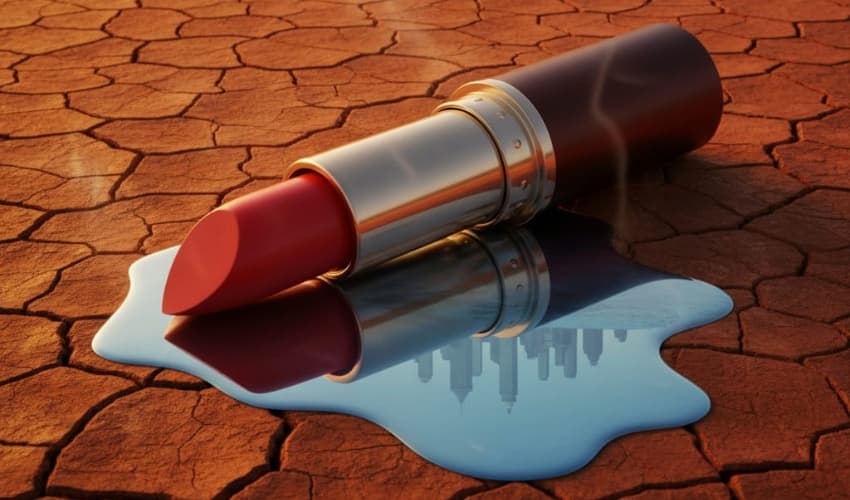
Whether you’re a housewife or a working woman, we’ve all faced that tiny frustration where you reach into your purse to fix your makeup, only to find that your lipstick has melted or your compact powder has crumbled. It might be a small annoyance, but also a reminder of how everyday heat is disrupting our routines.
Sometimes the smallest things tell the biggest stories. A lipstick that melts in your bag, a chocolate bar that softens before you can eat it, or butter that gives up in minutes. It’s easy to blame poor quality or careless storage. But deep down, we all know that it’s something else.
No one needs to be a scientist to notice these scary changes.
Just look around. Have you noticed the little changes around you lately? The ones we often ignore because they seem too small to matter? The truth is, the things that used to last for years now seem to give up within months.
The world is not only shifting enough to melt what’s in our hands, it’s also reshaping the future we’re handing to those who come after us.
These small signs are warnings of “Earth under stress”. The thing is, this changing climate is visible to each one of us. But we don’t pay attention to these signs, and, hence, the problem will only get bigger.
Big disasters may make headlines, but it’s these small changes that should make us pause. The days feel hotter than before and the seasons don’t seem to follow the rules we grew up with. Spring no longer whispers its arrival.
In Lahore and across Punjab and Sindh, April now arrives in full heat, bypassing the bloom entirely. Travel north and the change feels heavier. In Gilgit-Baltistan, June’s temperature touched 48.5 °C—that triggered glacial lake bursts which wiped out Hassanabad in a flash flood of ice-melt. Seventy-two lives were lost; entire villages vanished.
The problem is, we’ve grown used to the bad air that scratches our throats, to rains that no longer come when they should. We’ve started to see it as “normal”. But normal doesn’t flood your streets in minutes. Normal doesn’t turn your air toxic. Normal doesn’t wipe away entire towns.
This is change, accelerating before our eyes.
The question is – will we keep ignoring it until it knocks down our own door? Or will we act now, when there’s still time.
We can laugh it off, swipe it away, and carry on pretending it’s just “summer being summer.” Or we can pause and act. Because if we wait for more disasters to believe, we’ll be too late to stop it.