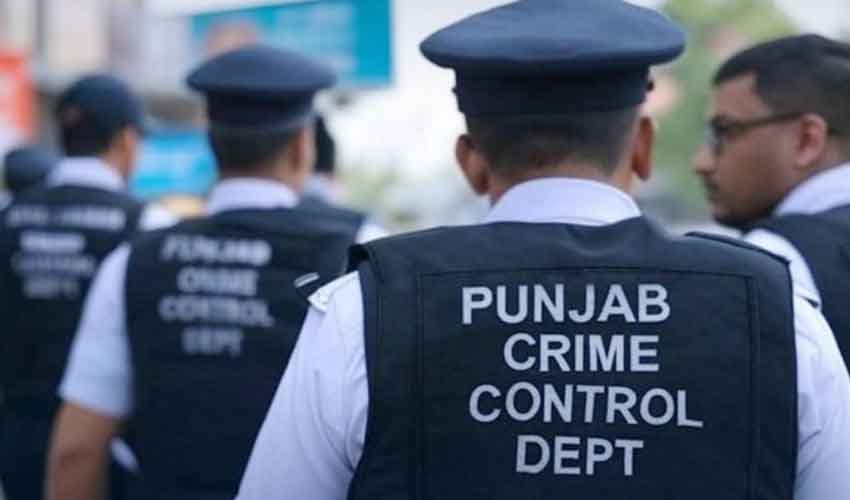
The Human Rights Commission of Pakistan (HRCP) has accused Punjab’s Crime Control Department (CCD) of adopting a deliberate policy of staged police encounters, many of which it says amount to extrajudicial killings.
In a detailed fact-finding report, the commission has called for an urgent high-level judicial inquiry, warning that the pattern of killings fundamentally undermines the rule of law and constitutional protections in the province.
According to HRCP, at least 670 CCD-led encounters were reported in the press during eight months of 2025. These incidents resulted in the deaths of 924 suspects, while only two police officers were killed in the same period.
The commission noted that the extreme casualty imbalance -- averaging more than two fatal encounters daily -- along with similar operational patterns across districts, suggests an institutionalized practice rather than isolated misconduct.
Violations of domestic law
The fact-finding mission concluded that these operations reflect systematic violations of Pakistan’s domestic laws and international human rights commitments.
Under the Torture and Custodial Death (Prevention and Punishment) Act 2022, the Federal Investigation Agency (FIA) is required to investigate every custodial death under the supervision of the National Commission for Human Rights (NCHR).
However, HRCP found no evidence that this mandatory procedure was consistently followed in the cases it examined. In one petition reviewed, it was the court -- not authorities -- that directed the FIA to initiate an investigation.
The mission also observed that magisterial inquiries required under Sections 174–176 of the Code of Criminal Procedure appeared not to have been conducted.
Lack of transparency
HRCP expressed disappointment that the Punjab government, along with CCD and police officials, did not respond to its request for a meeting.
The commission said this lack of engagement signals institutional unwillingness to address credible allegations of grave human rights violations.
The report highlights a pervasive climate of fear among victims’ families. In one case, relatives alleged they were pressured by police to bury the deceased immediately. They also claimed they were warned that other family members could be killed if they pursued the matter further.
HRCP described such intimidation as criminal conduct and a fundamental obstruction of justice.
Concerns over use of force, ‘uniform narratives’
The mission found that CCD operations failed to comply with the UN Basic Principles on the Use of Force and Firearms by Law Enforcement Officials, which require that lethal force be used only when absolutely necessary and proportionate.
In nearly every case reviewed, official press releases and first information reports followed a similar narrative: suspects allegedly fired first, police acted in self-defence, and those killed were described as “hardened” criminals.
The commission said this near-uniform messaging suggests orchestrated communication rather than independent operational outcomes.
Call for moratorium, independent oversight
HRCP stressed that sustainable public safety cannot be achieved through what it termed “lethal shortcuts” that bypass investigation, prosecution, and judicial accountability.
Among its recommendations, the report calls for:
-
An immediate province-wide moratorium on all encounter operations
-
A comprehensive high-level judicial inquiry into encounter-related deaths
-
Mandatory FIA investigations into all such deaths under NCHR supervision
-
The establishment of an independent civilian police oversight commission
-
Mandatory compensation for families of individuals killed in encounter operations