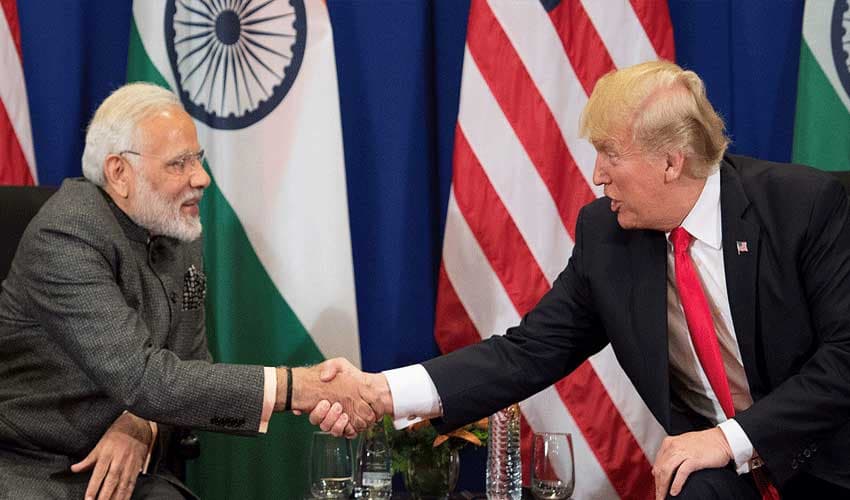
The United States and India moved closer to a trade agreement on Friday after releasing an interim framework aimed at reducing tariffs, reshaping energy ties and expanding economic cooperation, as both sides seek to realign global supply chains.
In a joint statement, the two governments said the framework reaffirmed their commitment to negotiations on a broader bilateral trade agreement, while noting that further talks were required to finalise the deal.
US President Donald Trump said earlier this week that Washington had agreed to reduce tariffs on Indian goods to 18 per cent from 50 per cent, in exchange for India halting purchases of Russian oil and lowering trade barriers.
Half of the original 50 per cent tariff had been imposed as a penalty for India’s imports of Russian oil, which Trump said were supporting Moscow’s war effort in Ukraine. On Friday, he signed an executive order withdrawing that 25 per cent levy after India agreed to shift its oil purchases to the United States and Venezuela.
India’s Trade Minister, Piyush Goyal, said in a post on social media platform X that the agreement protected farmers’ interests and rural livelihoods by fully safeguarding sensitive agricultural and dairy products. These include maize, wheat, rice, soya, poultry, milk products, ethanol, tobacco, as well as certain vegetables and meat.
India’s opposition Congress party criticised the agreement, saying it had been concluded largely on US terms and harmed farmers and traders, describing it as a deal that compromised national interests.
Friday’s joint statement provided further detail beyond the outlines announced by Trump on Monday.
It confirmed that India would purchase goods worth $500 billion from the United States over five years, including oil, gas, coking coal, aircraft and aircraft parts, precious metals and technology products. The technology category includes graphics processing units commonly used in artificial intelligence applications, as well as equipment used in data centres.
India also agreed to remove or lower tariffs on all US industrial goods and a wide range of American food and agricultural products. These include dried distillers’ grains and red sorghum for animal feed, tree nuts, fresh and processed fruit, soybean oil, wine and spirits.
However, the agreement will retain an 18 per cent tariff on most Indian exports to the United States, including textiles and garments, leather and footwear, plastics and rubber, organic chemicals, home décor, handicrafts and certain machinery.
Under the framework, India will receive the same tariff concessions granted to other US allies on specific aircraft and aircraft parts, along with a quota for auto parts subject to a reduced tariff rate.
The statement added that, depending on the outcome of the Trump administration’s investigation into pharmaceuticals and their ingredients, India would receive negotiated terms covering generic medicines and related inputs.
Goyal welcomed the framework, saying it opened access to a market worth $30 trillion — equivalent to annual US GDP — for Indian exporters, particularly farmers, fishermen and micro, small and medium-sized enterprises.
He said on Thursday that Washington and New Delhi aimed to sign a formal trade agreement in March, after which India’s tariff reductions on US exports would take effect.
Acceptance of US standards
India also agreed to address long-standing non-tariff barriers affecting imports of agricultural products, medical devices and communications equipment. Negotiations are expected to conclude within six months on recognising US or international safety and licensing standards for imported goods.
The United States said it would consider India’s requests for lower tariffs during continued negotiations on the bilateral agreement. Both sides also agreed to cooperate on enforcing export controls on sensitive technologies and to respond to non-market practices by third countries, a reference to China.
The two countries have struggled for years to conclude a comprehensive trade agreement, with disputes covering agriculture, digital trade, medical devices and market access. Officials said strategic concerns, including competition with China, supply-chain diversification and energy security, have added urgency to the talks.