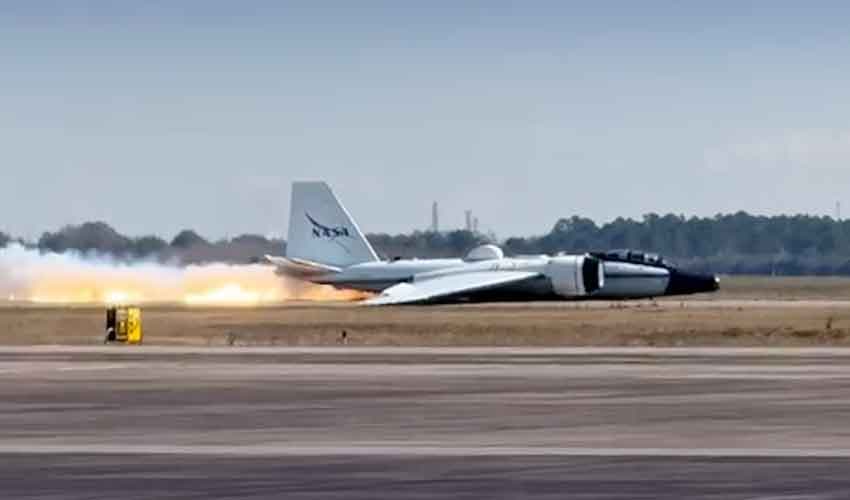
A NASA research aircraft made a dramatic emergency landing in Texas on Tuesday, sliding along the runway without its landing gear and sending flames and smoke into the air. All crew members aboard the plane were reported safe.
The incident occurred at around 11:30am when a NASA WB-57 research aircraft experienced a mechanical malfunction during landing.
The plane touched down at Ellington Airport, southeast of Houston, without its landing gear deployed, forcing it to slide along the runway on its belly.
Video shows flames and smoke
Video footage shared on social media shows the aircraft descending slowly before jolting onto the runway. As it made contact, yellow flames and white smoke burst from beneath the fuselage while the wings bounced during the impact.
The aircraft continued sliding as flames flared and faded amid thick smoke, gradually slowing before coming to a stop.
Crew safely evacuated
NASA confirmed in a post on X that the crew landed safely and that there were no injuries. According to the Houston Fire Department, two people were on board the aircraft at the time of the incident.
Local television footage from KHOU 11 showed the aircraft at rest with its cockpit hatch open, fire trucks on site, and emergency responders working near the plane’s blackened nose.
NASA spokesperson Bethany Stevens said the aircraft suffered a mechanical issue that led to the gear-up landing. She added that NASA would conduct a thorough investigation into the cause and promised transparent updates as more information becomes available.
Runway closed
Houston Airports Director of Aviation Jim Szczesniak said the runway was closed until the aircraft could be removed. He confirmed that first responders, including personnel from a military subcontractor, were dispatched to manage the situation and secure the area.
About NASA WB-57 aircraft
The aircraft involved was a WB-57, a high-altitude research plane operated by NASA Johnson Space Center.
Designed with a long, thin fuselage, the WB-57 can fly for more than six hours at altitudes exceeding 63,000 feet and carries scientific payloads operated by a pilot and a sensor equipment operator seated in tandem.
NASA said the WB-57 aircraft have been flying research missions since the early 1970s and remain a key asset to the scientific community.
Three of the specialized planes are currently operated out of the Johnson Space Center in Houston as part of NASA’s WB-57 High Altitude Research Program.