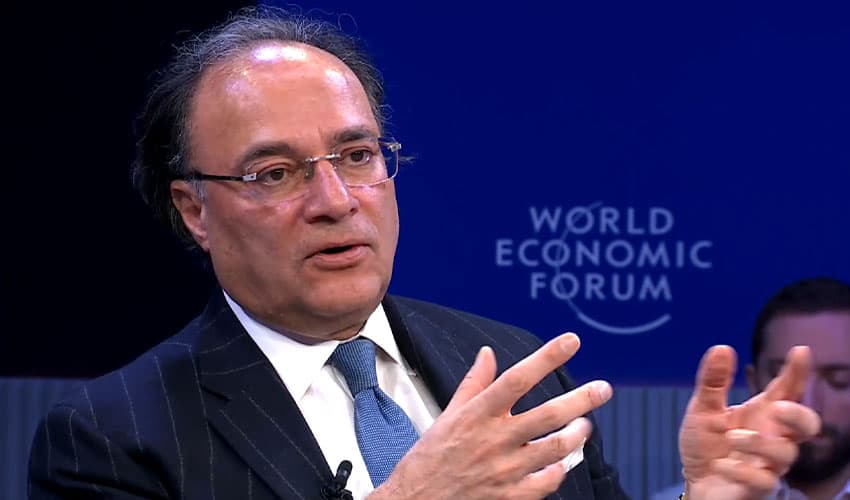
Finance Minister Aurangzeb said debt is not harmful if allocated to productive investments, highlighting fiscal reforms, export-led growth, and climate resilience at the World Economic Forum in Davos on Wednesday.
Speaking at a high-level panel in Davos, Aurangzeb emphasized that borrowing can be beneficial if directed toward projects that generate exportable surplus rather than consumption.
“For countries like Pakistan, debt must be channeled into investments that create long-term economic value,” he said, underlining the importance of fiscal discipline in emerging economies.
He highlighted Pakistan’s recent economic achievements, including reducing the debt-to-GDP ratio from 75% to 70%, achieving a primary fiscal surplus, and bringing inflation down from 38% to single digits. The central bank has also cut the policy rate to 10.5%, signaling improved macroeconomic stability.
RELATED: Pakistan’s external debt rises sharply in six months
Aurangzeb pointed to the Reko Diq copper project, expected to generate $2.8 billion in annual exports after 2028, as an example of productive investment. He also cited growth opportunities in IT, freelancing, and digital services, aligning with Pakistan’s pivot toward an export-driven economy.
The finance minister noted that public-private partnerships and capital markets, including Pakistan’s inaugural Panda bond—a green bond entering China’s capital markets—are playing a growing role in financing development.
Climate change and resilience
Aurangzeb highlighted climate change as a major ongoing threat to Pakistan, noting that the country successfully handled recent floods using domestic resources without appealing for international aid.
He stressed that resilience and effective implementation, rather than funds alone, are critical to mitigating the economic impact of climate-related disasters.
The finance minister is part of Pakistan’s delegation led by Prime Minister Shehbaz Sharif, who also spoke about shifting toward an export-driven growth model focused on minerals, information technology, artificial intelligence, and digital services.
Aurangzeb’s remarks underscore Pakistan’s approach to balancing fiscal discipline, strategic debt use, and climate resilience to support long-term growth.