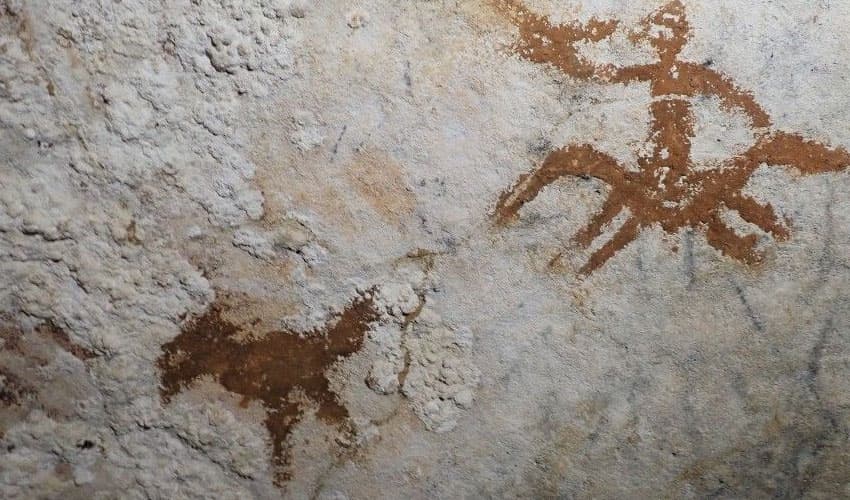
Archaeologists have uncovered the oldest known cave paintings in the world on Indonesia’s Muna Island.
Hand stencils found on limestone walls are estimated to be up to 67,800 years old, revealing the artistic and cultural sophistication of early humans in the region.
Researchers from Indonesia and Australia analysed tan-coloured handprints made by blowing pigment over hands placed against cave walls. The oldest stencil was discovered beneath newer paintings depicting a person riding a horse alongside a chicken.
Lead researcher Adhi explained that it was initially challenging to prove the stencils were human hands, but closer inspection revealed fingertip shapes, some deliberately pointed.

“The oldest hand stencil described here is distinctive because it belongs to a style found only in Sulawesi,” said Maxime Aubert, archaeological science specialist at Griffith University in Australia.
Symbolic meaning behind the art
Co-author Adam Brumm, also from Griffith University, noted that the reshaped fingertips may have symbolized something beyond human hands, possibly animal claws.
“It suggests a deeper cultural meaning,” Brumm said, “reflecting ancient peoples’ complex symbolic relationship with the animal world, though the exact significance remains unknown.”
Precise dating techniques reveal age
The team determined the minimum age of the art by analysing uranium in mineral layers over the pigment. Calcite samples, just five millimetres wide, were lasered to measure uranium decay compared with stable thorium.
“This very precise technique gave us a clear minimum age for the painting,” Aubert said, confirming the artwork could be as old as 67,800 years.
The caves on Muna Island have been used repeatedly for rock art over millennia. Some images were painted over as recently as 35,000 years later, showing a long-standing tradition of human creativity in the region.
The discovery is more than 15,000 years older than previous cave art found in nearby Sulawesi by the same research team in 2024.
According to Adhi, the findings support theories of early human migration through Sulawesi and highlight the artistic talents of our ancestors.
“It also shows that our ancestors were not only great sailors but also artists,” he said. The discovery adds to evidence of ancient cultural activity in Southeast Asia, alongside nearby East Timor and Australia, where Aboriginal cultures have existed for at least 60,000 years.