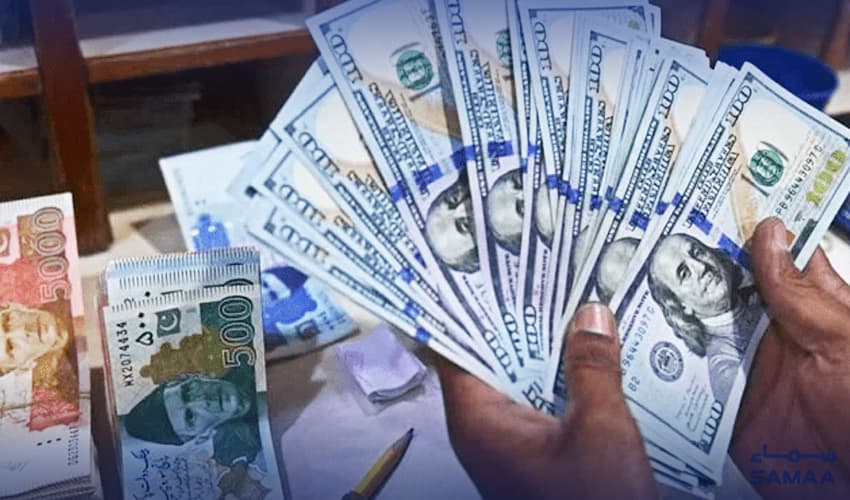
Pakistan’s dependence on external financing has increased markedly, with the country securing more than Rs1,272 billion in loans and grants during the first six months of the current fiscal year, according to official documents from the Economic Affairs Division.
Data shows that external loans rose by more than 29% compared to the same period last year, translating into an increase of over Rs280 billion.
From July to December, Pakistan received Rs1,254 billion in loans and Rs17.67 billion in grants, taking total external financial assistance to a record Rs1,272 billion.
Higher inflows from last fiscal year
In the first half of the previous fiscal year, Pakistan had received Rs974 billion in external loans. In dollar terms, the country secured $4.5 billion in six months -- $904 million more than the $3.6 billion obtained during the same period last year.
Also Read: Pakistan plans global bond issuance after four-year hiatus
According to the documents, Rs785 billion was received as non-project aid during the six-month period, while Rs487 billion came in the form of project assistance. Out of the non-project aid, Rs458.72 billion was allocated specifically for budgetary support.
Saudi Arabia, Islamic Development Bank support
Pakistan also benefited from oil financing facilities during this period. Saudi Arabia provided an oil facility worth Rs170 billion, while the Islamic Development Bank extended a loan of Rs137 billion, according to official figures.
Also Read: Islamic Development Bank approves $603mln loan for Pakistan
In addition to bilateral and multilateral assistance, Pakistan received a $1.2 billion tranche from the International Monetary Fund.
The country also raised $1.20 billion through Naya Pakistan Certificates, further adding to external inflows.
Oil imports through credit
Separately, Pakistan borrowed oil worth $600 million from Saudi Arabia, easing short-term pressure on foreign exchange reserves but increasing overall external liabilities.
Including IMF disbursements and other inflows, Pakistan’s external borrowing during the six-month period reached $5.7 billion.
The government has set a target of securing $20 billion in external debt during the current fiscal year, equivalent to around Rs4,507 billion.
The sharp rise in borrowing comes even as the government maintains that efforts are underway to reduce the country’s debt burden.
On the other hand, the International Monetary Fund recently revealed notable discrepancies between Pakistan’s official economic targets and projections by international financial institutions.
Also Read: IMF pegs Pakistan growth at 3.2%, below govt target
In its latest World Economic Outlook report, the IMF has estimated Pakistan’s economic growth at 3.2% for the current fiscal year. This projection is lower than the government’s official target, highlighting a growing divergence in assessments.
The IMF also pointed out a 0.4 percentage point decline in GDP growth compared to its October 2025 estimate, indicating a more cautious outlook for the economy.
Govt target higher than IMF estimate
In contrast, the Ministry of Finance has set an economic growth target of 4.2% for the current fiscal year. Officials maintain that policy measures and improved performance in key sectors will help achieve this goal.
The ministry also reported that GDP growth stood at 3.7% in the first quarter of the current fiscal year, providing some optimism about momentum in the early months.
Meanwhile, Pakistan’s current account has slipped back into deficit, ending a brief surplus streak, as rising imports outpaced exports, according to the State Bank of Pakistan.
Also Read: Pakistan current account slips into deficit in Dec
The State Bank of Pakistan reported that Pakistan recorded a current account deficit of $244 million in December. This marked a significant turnaround from the previous month.
In November, the country had posted a current account surplus of $100 million, offering short-lived relief to the external balance position.