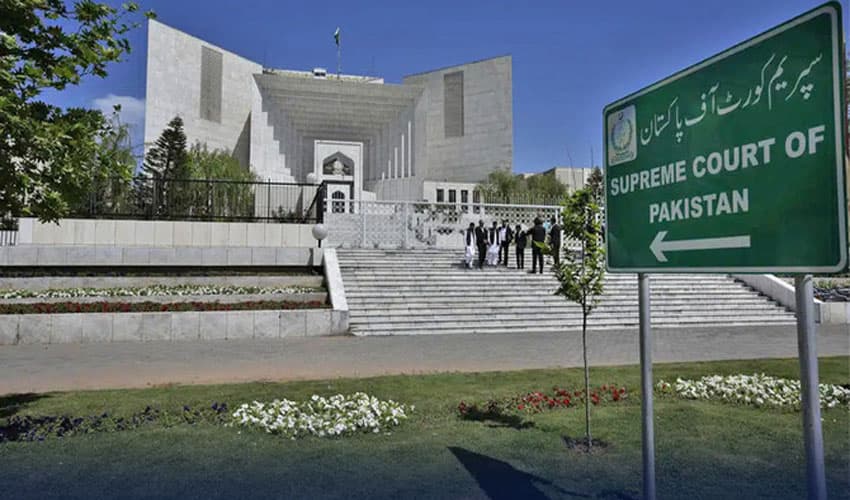
The Supreme Court acquitted on Tuesday three men in a 15-year-old murder case, setting aside a Lahore High Court ruling and raising serious concerns over investigation practices in murder cases across Punjab.
The top court quashed the Lahore High Court’s January 9, 2017 verdict and acquitted all three accused, citing major flaws in the prosecution’s case.
The matter was heard by a three-member bench comprising Justice Hashim Kakar, Justice Salahuddin Panhwar and Justice Ishtiaq Ibrahim. Justice Ishtiaq Ibrahim authored a detailed 10-page written judgment.
Serious questions on Punjab’s investigation methods
In its verdict, the court sharply criticised the investigation methods commonly used in murder cases in Punjab.
It observed that investigators often rely on stereotypical and conventional narratives, while “fictitious characters” are created to implicate multiple accused in a single incident. The court noted that such stories are frequently constructed in a manner that is “not humanly possible.”
The court also rejected the prosecution’s reliance on eyewitness testimony, declaring the oral account of witnesses unbelievable.
According to the verdict, it was not possible for witnesses to observe with such precision during a shooting incident that they could identify which accused’s bullet struck the victim. The bench held that this claim alone cast serious doubt on the prosecution’s version.
Background
The murder occurred on December 17, 2010, in Lodhran district, where Ghulam Sarwar was shot dead.
The prosecution claimed that all three accused were present at the scene and opened fire simultaneously. Following registration of the case, the accused were arrested and put on trial.
On September 24, 2011, the trial court sentenced two of the accused to death, while the third was awarded life imprisonment.
The Supreme Court noted that the medical evidence did not fully corroborate the eyewitness accounts.
It pointed out serious contradictions in witness statements and declared the recovery of the weapon and empty shell unreliable, further weakening the prosecution’s case.
The Lahore High Court had, in its January 9, 2017 decision, converted the two death sentences into life imprisonment while upholding the conviction of the accused.
However, the Supreme Court ruled that the prosecution failed to prove the commission of the offence and could not establish the presence of the witnesses at the crime scene beyond doubt.
Giving the benefit of doubt, the apex court acquitted Munir Ahmed, Zulfiqar alias Kala and Naseer Ahmed.
The judgment reaffirmed that even a single reasonable doubt in a criminal case is sufficient to entitle the accused to acquittal.