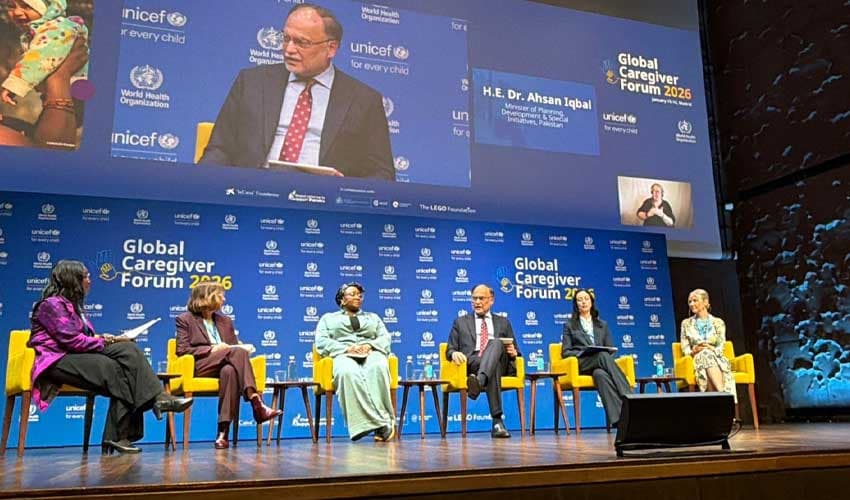
Federal Minister for Planning, Development & Special Initiatives Ahsan Iqbal participated in a high-level international event co-hosted by UNICEF, the World Health Organization (WHO), and the Spanish government.
The forum brought together global leaders and advocates to advance the critical agenda of child and family well-being through evidence-based caregiving strategies.
Addressing the first-ever Global Caregiver Forum, Ahsan Iqbal acknowledged the significance of this initiative while noting he carried the distinction of being the only male participant in the panel discussion.
"I think this forum should have taken place much earlier, but better late than never," the minister stated during the forum.
The event focused on developing a comprehensive global roadmap for scaling up evidence-based parenting programs aimed at supporting caregivers, strengthening families, and safeguarding children's rights and development. Senior representatives from governments, UNICEF, WHO, and international advocacy organizations shared best practices and policy perspectives on universal caregiver support as essential social infrastructure.
The minister highlighted a fundamental challenge confronting governments globally: the mismatch between political cycles and the timeline for social investment returns.
"The fundamental problem that we face in our governments is that governments run through five-year cycles, and these are the investments that do not give results in five years," he said during his address.
He explained that governments typically prioritize short-term investments that yield visible results within three to five years to secure reelection. Consequently, critical social investments in early childhood development are frequently overlooked despite their transformative long-term impact.
To address this structural challenge, he said, Pakistan has forged strategic partnerships with media and civil society organizations to create voices of accountability, ensuring that early childhood development remains a national priority beyond political cycles.
He stressed that investing in children's early years is not merely a matter of social well-being but represents a fundamental question of human rights and sound economic policy.