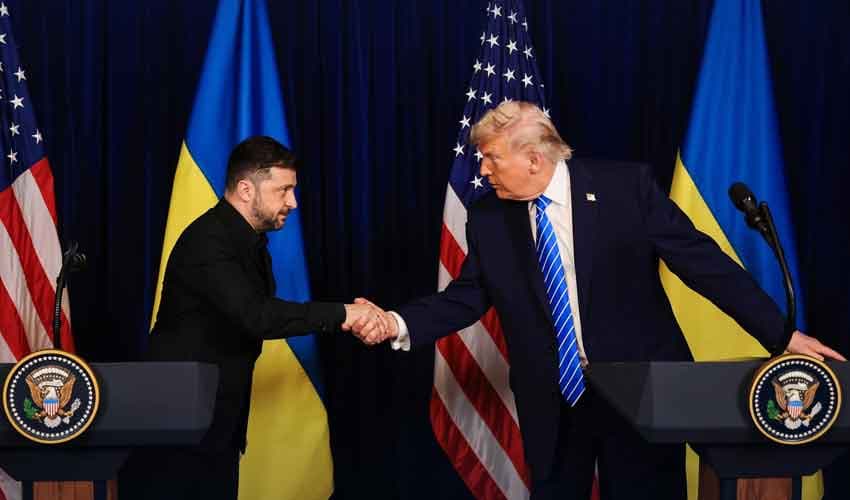
US President Donald Trump said on Sunday that he and Ukrainian President Volodymyr Zelenskiy were "getting a lot closer, maybe very close" to an agreement to end the war in Ukraine, while acknowledging that the fate of the Donbas region remains a key unresolved issue.
The two leaders spoke at a joint news conference after meeting at Trump's Mar-a-Lago resort in Florida on Sunday afternoon. Both leaders reported progress on two of the most contentious issues in peace talks - security guarantees for Ukraine and the division of eastern Ukraine’s Donbas region that Russia has sought to capture.
Both Trump and Zelenskiy offered few details and did not provide a deadline for completing a peace deal, although Trump said it will be clear "in a few weeks" whether negotiations to end the war will succeed. He said a few "thorny issues" around territory must be resolved.
Zelenskiy said an agreement on security guarantees for Ukraine has been reached. Trump was slightly more cautious, saying that they were 95% of the way to such an agreement, and that he expected European countries to "take over a big part" of that effort with US backing.
French President Emmanuel Macron, in an X post published after Trump met with Zelenskiy, said progress was made on security guarantees. Macron said countries in the so-called "Coalition of the Willing" would meet in Paris in early January to finalise their "concrete contributions."
Zelenskiy has said previously that he hopes to soften a US proposal for Ukrainian forces to withdraw completely from Donbas, a Russian demand that would mean ceding some territory held by Ukrainian forces. While Moscow insists on getting all of Donbas, Kyiv wants the map frozen at current battle lines.
Both Trump and Zelenskiy said on Sunday the future of the Donbas had not been settled, though the US president said discussions are "moving in the right direction." The United States, seeking a compromise, has proposed a free economic zone if Ukraine leaves the area, although it remains unclear how that zone would function in practical terms.
"It's unresolved, but it's getting a lot closer. That's a very tough issue," Trump said.
Nor did the leaders offer much insight into what agreements they had reached on providing security for Ukraine after the war ends, something Zelenskiy described Sunday as "the key milestone in achieving a lasting peace."
Russia has said any foreign troop deployment in Ukraine is unacceptable.
Zelenskiy said any peace agreement would have to be approved by Ukraine's parliament, or by a referendum. Trump said he would be willing to speak to parliament if that would secure the deal.
Trump, Putin speak before Zelenskiy meeting
Shortly before Zelenskiy and his delegation arrived at Trump's Florida residence, Trump and Russian President Vladimir Putin spoke in a call described as "productive" by the U.S. president and "friendly" by Kremlin foreign policy aide Yuri Ushakov.
Ushakov, in Moscow, said Putin told Trump a 60-day ceasefire proposed by the European Union and Ukraine would prolong the war. The Kremlin aide also said Ukraine needs to make a decision regarding the Donbas "without further delay."
Trump said he and Putin spoke for more than two hours. He said the Russian president pledged to help rebuild Ukraine, including by supplying cheap energy. "Russia wants to see Ukraine succeed," Trump said. "It sounds a little strange."
Also Read: ‘US has become the real United Nations’, says Donald Trump
As Trump praised Putin, Zelenskiy tilted his head and smiled.
Trump said he would call Putin again following the meeting with Zelenskiy.
The Kremlin expressed support for Trump's negotiations.
"The whole world appreciates President Trump and his team’s peace efforts," Kirill Dmitriev, Putin's special envoy, posted on X early on Monday after Trump’s talks with Zelenskiy.
Nuclear plant discussed
US negotiators have also proposed shared control over the Zaporizhzhia nuclear plant. Power line repairs have begun there after another local ceasefire brokered by the International Atomic Energy Agency, the agency said on Sunday.
Negotiators, Trump said, have made progress on deciding the fate of the plant, which can "start up almost immediately." The US president said "it's a big step" that Russia had not bombed the facility.
Russia controls all of Crimea, which it annexed in 2014, and since its invasion of Ukraine nearly four years ago has taken control of about 12% of its territory, including about 90% of the Donbas, 75% of the Zaporizhzhia and Kherson regions, and slivers of the Kharkiv, Sumy, Mykolaiv and Dnipropetrovsk regions, according to Russian estimates.
The day before Zelenskiy arrived in Florida to meet with Trump, Russian forces attacked Kyiv and other parts of Ukraine with hundreds of missiles and drones, knocking out power and heat in parts of the Ukrainian capital. Zelenskiy has described the weekend attacks as Russia's response to the US-brokered peace efforts, but Trump on Sunday said he believes Putin and Zelenskiy are serious about peace.
After Saturday's air attacks, Putin said Moscow would continue waging its war if Kyiv did not seek a quick peace. Russia has steadily advanced on the battlefield in recent months, claiming control over several more settlements on Sunday.
European heads of state joined at least part of Sunday's meeting by phone. European Commission President Ursula von der Leyen said on social media site X that "Europe is ready to keep working with Ukraine and our US partners," and added that having ironclad security guarantees will be of "paramount" importance.
A spokesman for UK Prime Minister Keir Starmer said European leaders "underlined the importance of robust security guarantees and reaffirmed the urgency of ending this barbaric war as soon as possible.”
20-point peace proposal Trump, Zelenskiy likely discussed
A draft 20-point framework peace proposal is expected to be at the centre of talks between Ukrainian President Volodymyr Zelenskiy and his US counterpart Donald Trump in Florida on Sunday.
Zelenskiy has said the plan could become the basis of a future agreement to end the war with Russia.
After weeks of talks to modify an earlier 28-point draft seen as supporting many of Russia's main demands, Zelenskiy said this week that most positions had been brought significantly closer.
Ukraine and the United States still had not reached consensus on two main points - control of territory and of the Zaporizhzhia nuclear power plant - but Zelenskiy has said he hopes to discuss both with Trump.
Below are the points of the draft proposal as unveiled by Zelenskiy and shared by his office this week.
- Ukraine’s sovereignty will be reaffirmed.
- This point will envisage a full and unquestionable non-aggression agreement between Russia and Ukraine. It specifies that to sustain long-term peace, a monitoring mechanism will be established to oversee the line of contact through space-based unmanned monitoring, to ensure early notification of violations, and to resolve conflicts.
- Ukraine will receive robust security guarantees.
- Ukraine will maintain its armed forces at their present strength of 800,000 personnel. The earlier US draft had called for Ukraine to reduce the size of its forces.
- The United States, NATO, and European countries will provide Ukraine with security guarantees that mirror Article 5, the mutual-defence clause of NATO's founding treaty.
- Russia will formalise a policy of non-aggression towards Europe and Ukraine in all necessary laws and all required documents on ratification, including ratification by an overwhelming majority vote in the State Duma.
- Ukraine will become an EU member at a specifically defined date. Ukraine will also receive short-term preferential access to the European market.
- Ukraine will receive a strong global development package, which will be defined in a separate agreement on investment and future prosperity.
- Several funds will be established to address economic recovery, the reconstruction of damaged areas and regions, and humanitarian issues. The objective will be to mobilize $800 billion to help Ukraine fully realize its potential.
- Ukraine will accelerate the process of concluding a free-trade agreement with the United States. Zelenskiy said the US position was that if Washington were to grant free trade access to Ukraine, it aimed to offer similar terms to Russia.
- Ukraine will confirm that it will remain a non-nuclear state, in accordance with the Treaty on the Non-Proliferation of Nuclear Weapons.
- The Zaporizhzhia nuclear power plant. Zelenskiy said no agreement had yet been reached with the United States on the issue of Europe's biggest nuclear power plant, which is located near the front line in territory now controlled by Russian forces. Zelenskiy said the US proposal was for the plant to be operated jointly by Ukraine, the United States, and Russia, each holding equal stakes in a joint enterprise, with the Americans acting as the chief managers. Kyiv's proposal was for the plant to be operated by a 50-50 joint enterprise involving only the United States and Ukraine, with Ukraine receiving half of the energy produced and the United States independently allocating the other half.
- Ukraine and Russia commit to implementing educational programmes in schools and across society that promote understanding and tolerance toward different cultures and eliminate racism and prejudice. Ukraine will implement European Union rules on religious tolerance and the protection of minority languages.
- Territory: Zelenskiy said that this was the most complex point, and as yet unresolved. Russia wants Ukraine to withdraw troops from territory Ukraine still controls in the eastern Donetsk region. Kyiv wants fighting to be halted at current battle lines. Washington has proposed demilitarised zones and a free economic zone in the part of the Donetsk region that Kyiv controls.
- After reaching an agreement on future territorial arrangements, both Russia and Ukraine undertake not to alter these agreements by force.
- Russia will not obstruct Ukraine from using the Dnipro River and the Black Sea for commercial purposes. A separate maritime agreement and an access agreement will be concluded, covering freedom of navigation and transport. The Kinburn Spit, along the Dnipro's outlet to the sea, will be demilitarized.
- A humanitarian committee will be established to resolve outstanding issues:
- All remaining prisoners of war will be exchanged on the principle of All for All.
- All civilian detainees and hostages will be returned, including children.
- Provisions will be made to address the suffering of victims from the conflict.
- Ukraine must hold elections as soon as possible after the signing of the agreement.
- This agreement will be legally binding. Its implementation will be monitored and guaranteed by a Peace Council, chaired by President Trump. Ukraine, Europe, NATO, Russia, and the United States will be part of this mechanism. Sanctions will apply in case of violations.
- Once all parties agree to this agreement, a full ceasefire will take effect immediately.