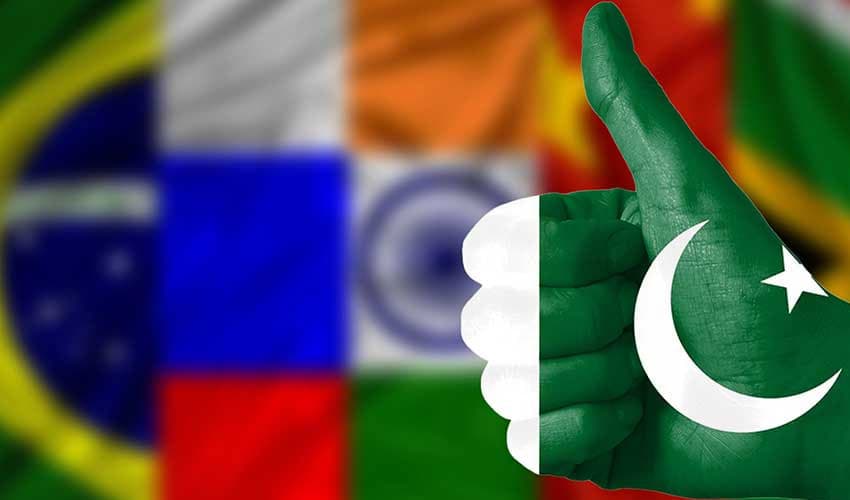
Pakistan has formally expressed its interest in joining BRICS, the bloc of emerging economies, as the country seeks to expand trade, digital innovation, and strategic cooperation with member states.
Federal Finance Minister Muhammad Aurangzeb outlined the vision in an interview with Azerbaijani and Russian media.
Finance Minister Aurangzeb emphasized that joining BRICS could open avenues for alternative payment systems, enhance North-South economic cooperation, and strengthen trade and transport corridors.
He noted that Pakistan is actively discussing energy, minerals, and even the potential establishment of a steel plant with Russia, highlighting efforts to stabilize the economy and build investor confidence.
Aurangzeb stressed the importance of fintech, digital currency regulation, artificial intelligence, and cybersecurity in Pakistan’s economic strategy.
Work is underway to create a Virtual Assets Regulatory Authority to oversee cryptocurrencies and digital finance.
The Finance Minister also highlighted AI’s potential to revolutionize agriculture, healthcare, finance, and freelance productivity, promising new opportunities for income growth and innovation.
Understanding BRICS
BRICS currently comprises Brazil, Russia, India, China, and South Africa, representing some of the world’s largest emerging economies.
Formed in 2006 (as BRIC) and expanded to BRICS in 2010 with South Africa’s inclusion, the bloc aims to enhance economic cooperation, development, and political dialogue among its members.
Membership would potentially allow Pakistan to access new trade networks, investment opportunities, and development funds.
Strategic benefits for Pakistan
Joining BRICS could provide Pakistan with:
-
Access to alternative payment systems beyond traditional Western channels.
-
Expanded trade and transport corridors connecting Asia, Europe, and Africa.
-
Collaboration on energy projects, minerals, and industrial growth.
-
Opportunities to integrate AI and fintech into key sectors of the economy.
Aurangzeb emphasized that economic stability and regulatory frameworks are essential to attract global investors and strengthen Pakistan’s position on the international stage.