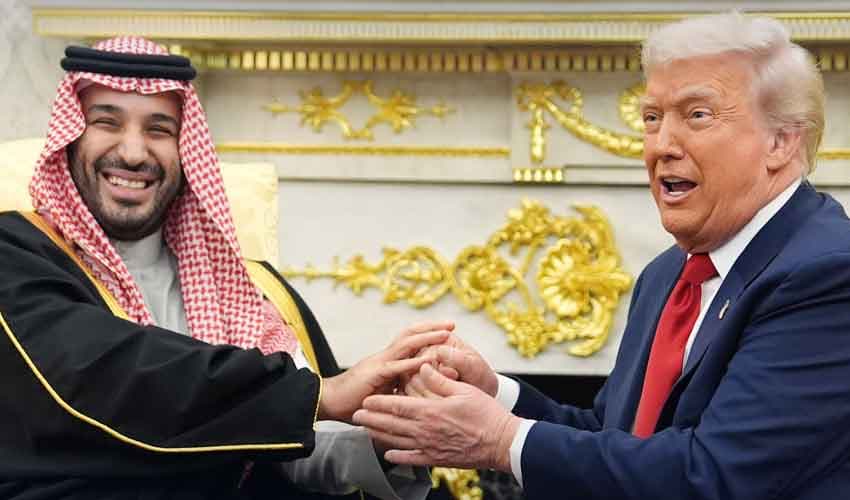
A high-stakes meeting between US President Donald Trump and Saudi Crown Prince Mohammed bin Salman last week became unexpectedly heated when the two clashed over the timing of Saudi Arabia joining the Abraham Accords, according to US officials and sources familiar with the discussion.
The president had hoped the post-Gaza-war moment would pave the way for a breakthrough on Saudi-Israeli normalization. Instead, he left the conversation “disappointed and angry,” officials told multiple outlets.
According to US officials, the White House informed MBS ahead of the Nov 18 meeting that Trump expected tangible movement on normalization with Israel. During the closed-door session, Trump personally raised the issue and pushed vigorously for Saudi Arabia to join the Abraham Accords — a signature foreign policy achievement of his first term.
At that point, the atmosphere shifted. Despite exchanging polite remarks in public, the private discussion grew tense as MBS firmly resisted pressure.
Sources say the crown prince stressed that while he supports normalization in principle, the aftermath of the Gaza war has made the political climate in Saudi Arabia deeply hostile toward Israel. Public opinion, he said, simply will not tolerate such a step right now.
One source summarized the tone: “Disappointment and irritation. The president really wants them in the Abraham Accords… but MBS is a strong man. He stood his ground.”
MBS demands credible path to Palestinian statehood
The crown prince reiterated a condition he also stated publicly: normalization cannot proceed unless Israel commits to “an irreversible, credible and time-bound path” toward a Palestinian state. This remains a red line for Riyadh.
A US official emphasized that MBS did not close the door entirely. “He never said no to normalization. The door is open for doing it later. But the two-state solution is an issue.”
Israel’s government, however, continues to reject any path to Palestinian statehood. Prime Minister Benjamin Netanyahu recently declared that “there will not be a Palestinian state,” even if it jeopardizes normalization with Saudi Arabia.
Yet he also suggested that “conditions could develop” for a future agreement — if Israel’s security concerns are fully protected.
White House: Trump wants all Middle Eastern states in accords
A senior White House official framed the meeting within Trump's broader regional vision.
“Now that Iran's nuclear program has been totally obliterated and the war in Gaza has ended, it is very important to President Trump that all Middle Eastern countries join the Abraham Accords,” the official said.
F-35 tensions add another layer to talks
Complicating matters further, Trump told MBS during their joint remarks that Saudi Arabia would receive the same advanced F-35 fighter jets that the US sells to Israel. But a day later, Secretary of State Marco Rubio assured Netanyahu that this would not happen.
US and Israeli officials confirmed that Rubio clarified the Saudis would receive a downgraded variant of the aircraft. He also pledged the US would maintain Israel’s legally protected Qualitative Military Edge (QME).
“We told the Israelis we are committed to the QME and we are not going to violate it,” a US official said.
Despite its significance, Trump did not raise the ongoing terrorism lawsuit filed by families of 9/11 victims against Saudi Arabia. A US judge recently allowed the case to move forward, citing overwhelming evidence of potential Saudi involvement in the 2001 attacks that killed 2,977 people.
Israeli media confirms US frustration
Israel’s Channel 12 News likewise reported that Trump was left “disappointed and angry” after MBS refused to move forward. Officials stressed that the exchange remained civil but “tough,” underscoring the widening gap between Washington’s urgency and Riyadh’s domestic constraints.
Door open — but only on Saudi terms
For now, normalization is stalled by Saudi public sentiment and the crown prince’s insistence on a concrete path to Palestinian statehood — a condition the current Israeli leadership firmly rejects.
The door remains open, but only when political realities “ripen,” as Netanyahu put it. Until then, Trump’s aspirations for an expanded Abraham Accords face significant hurdles.