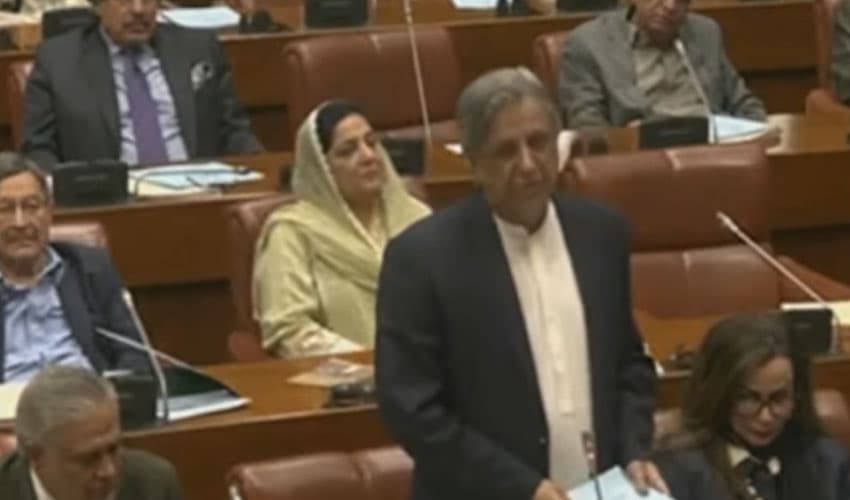
The Senate on Monday approved the 27th Constitutional Amendment Bill with two-thirds majority. The bill secured 64 votes in favour and none against.
The result was announced by the Senate chairman following a division of votes. The results came after the House approved the bill clause-wise following its introduction by Law Minister Senator Azam Nazir Tarar.
The session witnessed heated protests from opposition members, who tore up copies of the agenda in protest.
The 27th Constitutional Amendment Bill was presented in the form of a standing committee report. Senator Farooq H. Naik, Chairman of the Senate Standing Committee on Law and Justice, briefed members on the key points, highlighting significant reforms, including the establishment of a Federal Constitutional Court with equal provincial representation and the inclusion of a technocrat and an Islamabad High Court representative.
High court judges must have at least five years of experience, and appointments to the Supreme Court will not affect seniority. The committee also maintained the suo motu clause, stipulating that it will only be exercised when a formal application is filed.
Clause-wise approval and protests
The Senate began approving the amendment clause by clause. Members were instructed by the chairman to stand in their seats if they wished to support a clause.
However, the session was marked by a noisy opposition protest. Members opposed to the bill disrupted proceedings and voiced concerns over various clauses, including presidential immunity and judicial reforms.
Opp lawmakers vote in favour
The opposition staged a walkout during the session. JUI-F’s Ahmed Khan and PTI’s Saifullah Abro remained present in the house. Both lawmakers voted in favour of the amendment.
“Our party constitution and the Senate’s rules were violated by Kamran Murtaza,” a party member said. Kamran Murtaza added, “Action will be taken once Maulana Fazlur Rehman returns from Bangladesh.”
He further stated, “Article 62 will be applied to those who vote against the party policy. Any member who violates the party constitution will lose their Senate membership.”
Senator Hamid Khan also walked out of the Senate session, saying, “I regret that Saifullah Abro voted in favour of the amendment. The amendment goes against the Constitution and democracy.”
PTI leader Ali Zafar said, “We had instructed our parliamentary party that no one should vote in opposition. A member voted against our policy, and we will take action against Saifullah Abro under Article 62. He will not remain part of our party, and his membership will also be terminated.”
Senate chairman's on passage of 27th Amendment
Senate Chairman Yousuf Raza Gilani announced that 64 votes were cast in favour of the Constitutional Amendment Bill. He noted that government Senator Irfan Siddiqui was currently on a ventilator and therefore could not participate in the voting.
“I did not cast my own vote either,” Gilani stated. “I could have voted, but I chose not to. My aim was to ensure that the opposition had the opportunity to play its role.”
He added that the opposition presented its views, delivering 47 speeches during the debate. “Everyone had signed the Charter of Democracy,” he reminded, emphasizing that efforts were made to reach a broader consensus.
“As the custodian of both Houses, I ensured that the opposition was given full opportunity to express its opinion. Members from both sides were encouraged to participate to the maximum extent,” Gilani said.
Drawing parallels with the 18th Amendment, he noted that “there were more than 180 votes in the 1973 Constitution. Even with the remaining members in East Pakistan at that time, we managed to give the country a unanimous constitution.”
He further recalled that during the Charter of Democracy, 164 members unanimously approved the document. “All political parties, including the prime minister, have once again tried to build consensus,” he added.
Gilani also highlighted that Farooq H. Naik and members of the Law Committee conducted a three-day debate on the amendment.
“Education and population are ticking time bombs,” he remarked, stressing that both the government and the opposition must work together to address national challenges.
Addressing the media, the chairman said, “I want to make it clear that nothing was bulldozed. Wherever there were objections or names used without consensus, they were immediately removed. Everyone tried to fulfill their constitutional responsibilities to the best of their ability.”
Provincial and coalition proposals
Coalition partners raised additional amendments:
-
MQM: Proposed reforms to local governments and development funds, partially opposed by PPP.
-
Other Coalition Parties: Submitted three additional amendments.
-
Provincial Changes: Included renaming Khyber Pakhtunkhwa to Pakhtunkhwa and increasing Balochistan Assembly seats.
The amendments require a two-thirds majority for approval in both houses – 64 votes in the Senate and 224 in the National Assembly. While 30 opposition senators are expected to oppose the bill, government coalition leaders are coordinating to secure maximum support.
Key provisions of the amendment
The proposed 27th Amendment outlines major changes to Pakistan’s judicial and executive structure. The Senate passed all 59 clauses of the bill.
An amendment under Article 42 to establish the Federal Constitutional Court has been approved. Similarly, an amendment to Article 63A replacing the word “Supreme” with “Federal Constitutional Court” has also been passed.
Amendments including the mention of the Federal Constitutional Court in Article 68 (regarding parliamentary debates) and other related paragraphs have been approved.
The amendment to Article 81, adding references to the Constitutional Court in both paragraphs, has also been passed.
The Federal Constitutional Court will comprise seven judges, as per the approved amendment.
An amendment to Article 93, empowering the Prime Minister to appoint seven advisors, has been approved. Likewise, the amendment to Article 100 replacing the word “Supreme” with “Federal Constitutional Court” has been endorsed.
The amendment to Article 130, increasing the number of advisors to the Chief Ministers, has also been approved.
Further, amendments adding the name of the Federal Constitutional Court to Article 165A and including it in the definition under Article 175 have been passed.
Major structural and judicial reforms
Significant changes have been introduced to Article 175A of the Constitution of Pakistan. A new chapter comprising Articles 175B to 175L has been added.
The number of judges of the Federal Constitutional Court will now be determined by an Act of Parliament or by the President, according to the approved amendment.
A judge of the Federal Constitutional Court must be a Pakistani citizen, and the age limit for judges has been set at 68 years.
A lawyer with at least 20 years of experience in constitutional law will be eligible to become a judge of the Federal Constitutional Court.
The term of the Chief Justice of the Federal Constitutional Court will be three years, and the permanent seat of the Court will be in Islamabad.
The decisions of the Federal Constitutional Court will be binding on all courts of Pakistan, including the Supreme Court. However, no decision of the Supreme Court will be applicable to the Federal Constitutional Court. The Supreme Court’s decisions will apply to all other courts except the Federal Constitutional Court.
Transfer of jurisdiction and powers
All public interest cases currently heard by constitutional benches will now be transferred to the Federal Constitutional Court.
A judge who has served in a High Court for at least five years will be eligible for appointment to the Constitutional Court.
An amendment to include the Chief Justice of the Federal Constitutional Court in the Judicial Commission has been approved.
Amendments to Article 175A, concerning the appointment of judges to the Supreme Court, have also been passed. The Chief Justice of the Federal Constitutional Court and the Chief Justice of the Supreme Court will both serve as members of the Judicial Commission. Additionally, one senior judge from each of the two courts will be included as members.
Suo motu powers and judicial transfers
The 27th Constitutional Amendment abolishes the Supreme Court’s power of suo motu notice, transferring this authority to the Federal Constitutional Court.
Amendments have been approved to delete Articles 184, 186, and 191A from the Constitution of Pakistan.
Further, the amendment to Article 200 has been passed, limiting the President’s power to transfer judges. The President may now transfer a High Court judge only on the recommendation of the Judicial Commission.
In cases of judicial transfers, the Chief Justice of the concerned High Court will be included as a member of the Judicial Commission.
An amendment granting the Supreme Judicial Commission the power to transfer judges has been approved.
The Chief Justice of a High Court cannot be transferred. Additionally, no judge senior to a Chief Justice will be transferred in a manner that affects the seniority of any court. The transferred judge will also not hold seniority over the Chief Justice of the receiving court.