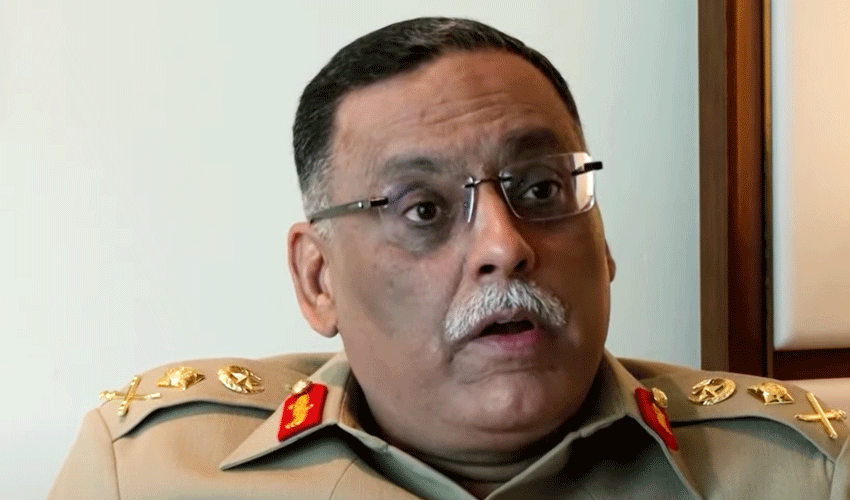
Chairman Joint Chiefs of Staff Committee General Sahir Shamshad Mirza has reaffirmed the strength of Pakistan-China relations, calling the friendship “higher than mountains, deeper than oceans, and stronger than steel” during an interview with Chinese media.
Speaking about the recent military engagement with India, General Mirza revealed that Pakistan employed the full spectrum of its national power --ranging from air and space to cyber capabilities -- to defend its sovereignty. He noted that the operational success was significantly bolstered by Pakistan’s advanced fighter jets, particularly the China-assisted JF-17 Thunder and J-10C aircraft.
“In the fight with India, we used all our capabilities, including air, space, and cyber domains,” he stated. “It was a synergetic effect that a multi-domain operation was conducted. The JF-17, J-10C and PL-15 fighter jets and missiles played a critical role in achieving operational success.”
He further stated that "full spectrum dominance was there, all tools of conflict -- AI, advanced warfare, cyber, aircraft, missiles were all synergised".
A few days ago, Gen Mirza had told Reuters that Pakistan and India were close to reducing the troop build-up along their border to levels before conflict erupted between the nuclear-armed neighbours this month, although he warned the crisis had increased the risk of escalation in the future.
Also Read: Pakistan, India close to border troop reduction: CJCSC
Both sides used fighter jets, missiles, drones, and artillery in four days of clashes, their worst fighting in decades, before a ceasefire was announced.
The spark for the latest fighting between the old enemies was an April 22 attack in Indian-occupied Kashmir that killed 26 people, most of them tourists. New Delhi blamed the incident on "terrorists" backed by Pakistan, a charge denied by Islamabad.
On May 7, India launched missiles at what it said were "terrorist infrastructure" sites across the border, and as Pakistan responded with its own attacks, both countries built up additional forces along the frontier.
Gen Mirza said the two militaries had started the process of drawing down troop levels.
Also Read: Pakistan’s top general warns India’s ambitions threaten regional stability
"We have almost come back to the pre-22nd April situation... we are approaching that, or we must have approached that by now," said Mirza, the most senior Pakistani military official to speak publicly since the conflict.
India's Ministry of Defence and the office of the Indian chief of defence staff did not immediately respond to Reuters' requests for comment on the remarks by Mirza.
Mirza, who is in Singapore to attend the Shangri-La Dialogue forum, said while there was no move towards nuclear weapons during this conflict, it was a dangerous situation.
"Nothing happened this time," he said. "But you can't rule out any strategic miscalculation at any time, because when the crisis is on, the responses are different."
Also Read: Pakistan fought 96-hour war against India without external support: CJCSC
Addressing the prestigious Shangri-La Dialogue, a global security summit held in Singapore, General Sahir Shamshad Mirza cautioned against India’s pursuit of regional hegemony, saying it undermines efforts to resolve conflicts in South Asia and threatens peace in the region.
He stressed that security arrangements cannot be effective without mutual trust and inclusive participation. He highlighted the urgent need for a comprehensive and institutionalised crisis management framework in South Asia and the broader Asia-Pacific region.
“Regional stability should not rest solely on military strength but on principles of trust, patience, and mutual respect,” he said, pointing to the longstanding Kashmir dispute, increasing India-Pakistan-China tensions, and the ongoing instability in Afghanistan as key challenges.